The cost-per-RP curve, and why those "bulk discount" bundles barely are one
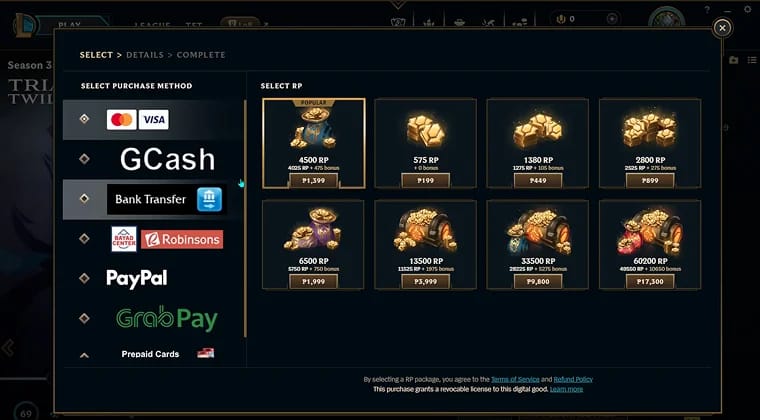
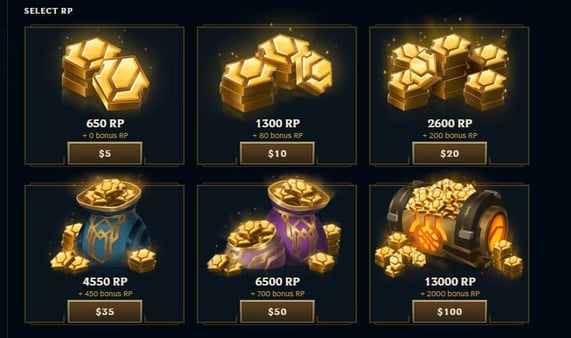
Official RP scales by pack, but the per-unit price moves way less than the marketing implies. On NA, the tiny pack is $4.99 for 575 RP, the giant one $99.99 for 13,500 RP, per the League of Legends Wiki RP page. Divide it out and the famous "buy in bulk and save" thing mostly vanishes.
| Pack Price (USD) |
RP Granted |
Cost per RP |
| $4.99 |
575 |
$0.0087 |
| $10.99 |
1,380 |
$0.0080 |
| $21.99 |
2,800 |
$0.0079 |
| $34.99 |
4,500 |
$0.0078 |
| $49.99 |
6,500 |
$0.0077 |
| $99.99 |
13,500 |
$0.0074 |
Source: League of Legends Wiki RP page (2026)
Smallest to largest pack: $0.0087 down to $0.0074 a point. That's a 15% improvement for buying twenty times the currency. What grabs me here isn't the saving, it's how flat the line goes once you clear the $10.99 tier. Hop from the $21.99 pack to the $99.99 brick and you save fractions of a cent per RP. If a skin costs you 2,800 RP and you grab the $99.99 monster to "save," congratulations, you've parked cash in Riot's account, not your own.
This is the baseline, and the baseline is the whole point. A legit channel can only carve a sliver off that $0.0074–$0.0087 range, so any listing vowing to cut it in half is basically holding up a sign.
Cheaper RP that's honest, versus the "too cheap" kind that isn't
There are a handful of legit reasons third-party RP comes in under official, and precisely one rotten reason that wrecks accounts.
The honest levers:
- Regional pricing. Riot prices RP per market, and a few markets are wildly cheaper once you convert. Turkey packs land roughly 50–70% under NA equivalents, per the Wiki's regional tables, with the storefront there listing 575 RP for ₺120 and 13,500 RP for ₺2,300.
- Bulk and promotions. Sellers buying gift codes in volume, or running thin-margin promos, can hand you a small but genuine saving.
- Gift-method delivery. Some platforms push RP through a "gift" route instead of crediting your account straight up, which per seller descriptions on Skycoach and Eldorado trims (doesn't kill) your exposure if the upstream funding goes sideways.
The rotten lever, the one responsible for every horror story, is RP bought with a stolen credit card. Community chatter and seller talk keep landing on the same number: deals at 50%+ off are the zone where stolen-card stock piles up (per Reddit threads and a heavily-shared Medium top-up write-up, 2026). And the logic's not complicated. If real RP runs about $0.0074–$0.0087 a point and somebody's flogging it at 60% off, where on earth is the profit? Nowhere. The "discount" is the fraud. You're buying currency the seller paid zero for, because the card funding it belonged to a stranger.
That flip is the entire trick of reading these listings. Why's third-party LoL RP cheaper than official? Sometimes it's geography. Sometimes it's laundered credit. The size of the discount is what tells you which one you're staring at.
What Riot's policy actually punishes (narrower than the panic claims)
Most "is third-party RP safe" pieces just crank the fear dial instead of reading the docs. Riot isn't out there hunting buyers for the crime of using a reseller. It moves on the chargeback.
The wording leaves no wiggle room. Riot Support (Chargebacks article, Apr 2026): "Your Riot Account will be suspended once a chargeback occurs." The Riot Global Refund Policy repeats it nearly verbatim: once a chargeback touches a Riot account, that account gets suspended. And per the same support docs, getting back in means paying back what's owed.
Sit with that mechanic, because almost nobody walks you through it. The real cardholder disputes the fraudulent charge, the processor reverses it, and Riot then claws back the RP that charge funded. Even if you already blew it on a skin. Your balance can go negative, the account sits on hold until you settle up, the RP's gone. The trigger was never "you bought from a reseller." It's "the money behind your RP got yanked."
Now, the separate Riot Terms of Service does ban unauthorized payment use and third-party stuff that breaks payment rules, so a blatant fraud channel is dead against the rules. But the part most guides whiff on: for an ordinary buyer, the everyday result isn't some surprise permanent ban dropping from the sky. It's a chargeback-reversal loss plus a hold. Hurts, often recoverable by repaying, still a loss. The ban hysteria's overcooked. The reversal risk is what people undersell.
So is buying discounted RP "against Riot's ToS"? A clean regional or gift-code buy sits in a grey zone Riot rarely chases. Funding it with stolen credit is the thing that drags it from grey to account-ending.
Official store next to a reputable alternative
The fair comparison was never "official good, third-party bad." It's about delivery type, region lock, and whether there's any way to dispute things if they go pear-shaped.
| Factor |
Official client store |
Reputable third-party channel |
Sketchy "too cheap" listing |
| Realistic saving |
Baseline |
~5–20% via region/bulk |
"50–60%+" (red flag) |
| Funding source |
Your payment, direct |
Legit gateway / gift codes |
Likely stolen-card |
| Delivery |
Instant account credit |
Code or gift method |
Account credit, opaque origin |
| Region lock risk |
None |
Possible if cross-region |
High |
| Dispute path |
Riot support |
Platform refund/dispute |
Usually none |
| Account exposure |
Minimal |
Low if gateway is real |
Chargeback reversal + hold |
A genuine alternative saves you somewhere around 5–20%, not 60%. Third-party RP often shows up 20–40% under official via regional keys or bulk, per AllKeyShop and G2A comparisons (2026), but that upper edge is precisely where you ease off and ask why before checkout. A 20% cut funded by region arbitrage is real. A 20% cut with no verifiable gateway and no refund page is a coin toss.
If you're going third-party anyway, the filter that genuinely counts is whether the platform runs verified payment gateways and shows its pricing openly. That's the lens to point at any League of Legends RP top up channel, VGTopup very much included, instead of chasing whatever sticker on the page is lowest.
The regional arbitrage trap nobody factors in
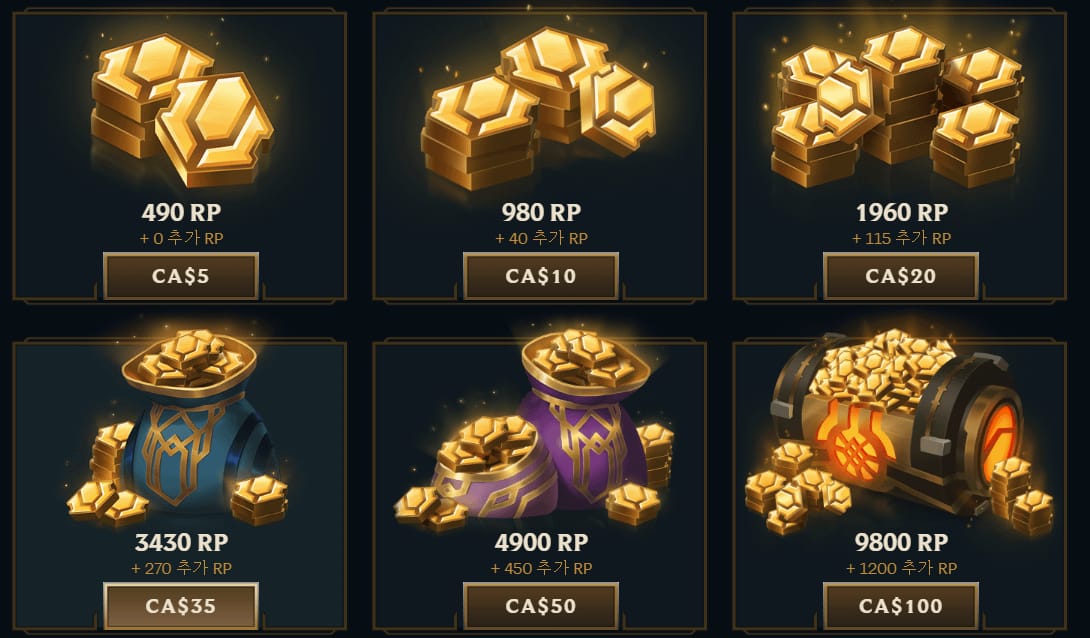
Buying RP in a cheaper region reads like free money. Turkey and LAN both undercut NA. LAN lists 475 RP for $3.99 against NA's 575 RP for $4.99, and 13,500 RP for $89.99 versus NA's $99.99, per the Wiki's 2026 tables. India and LATAM showed wobbly, sometimes-lower gaps after Riot's 2026 price tweaks, according to an esports.gg pricing report.
| Region |
Small pack example |
Large pack example |
| NA |
$4.99 / 575 RP |
$99.99 / 13,500 RP |
| EUW |
€4.99 / 575 RP |
€99.99 / 13,500 RP |
| Turkey |
₺120 / 575 RP |
₺2,300 / 13,500 RP |
| LAN |
$3.99 / 475 RP |
$89.99 / 13,500 RP |
Source: League of Legends Wiki RP page (2026)
What the sellers quietly mumble past is region lock. RP topped up on the wrong region can get marooned behind a lock you can't easily reverse, per a G2A Riot Points guide. Your main's on NA, you buy Turkey RP, and that balance now lives on a Turkey-region account that can't cross over. The arbitrage only pays if your account already calls that region home. Otherwise you've bought currency you can admire and never actually spend on the profile you play. Bake that in and the "70% cheaper" Turkey number folds for basically anyone outside MENA.
What a scam RP listing actually looks like
You don't need a payments degree to clock the fraud channels. The tells travel in a pack:
- A discount way under the cost-per-RP floor. Anything bragging 50%+ off the $0.0074–$0.0087 baseline. No honest profit lives down there.
- No verifiable payment gateway. Real platforms run through recognizable, secured gateways. Direct-to-wallet, crypto-only, or "DM me to pay" is a flag.
- No refund or dispute policy. Eneba's hub and Reddit warnings (2026) keep documenting buyers left with zero recourse on shady sellers. Money gone, no road back.
- Account-credit delivery from a mystery origin. A gift-code or redemption path is more see-through than some stranger crediting RP to your account from a source you'll never glimpse.
- Pressure and urgency. "Limited stock, pay now" exists for one job: stopping you from running the numbers above.
The Medium author's rule of thumb still holds up fine. Bigger, established third-party sellers beat unknown ones even when they cost a touch more, because reputation drags scam risk down. Cheaper-than-everybody isn't the prize. Cheaper-than-official-with-a-real-gateway is.
A checklist I'd run before paying anyone
Decided a third-party top-up's worth it? This is the order I'd genuinely move through:
- Run the cost-per-RP. Price divided by RP. If it dives way under $0.0074, walk.
- Confirm the gateway. Pay only through a recognizable, secured processor. Never a transfer to somebody's personal wallet.
- Check the delivery type. Favour code/gift delivery you redeem yourself over murky account-credit.
- Find the refund page. No dispute path, no purchase.
- Match the region. Buy for the region your account actually lives in, or risk stranding the balance.
- Lock 2FA first. Turn on Riot 2FA before you spend anything. Without it, a compromised account can lose the RP you just bought, a recurring note across 2026 security warnings in community groups.
That 2FA step isn't padding. Reused passwords and no second factor are exactly how accounts get drained of the very RP you bought to save a few bucks. Cheapest mistake on this list, and the easiest one to dodge.
Who should buy what, three honest profiles
The F2P bargain-hunter. Skip third-party completely. The Reddit consensus for zero-spend players in 2026 is unanimous and I'm right there with it: any ban or reversal risk outweighs a discount you didn't need. Free RP through official events and missions, or nothing at all.
The casual skin-buyer. For the odd $10–$20 grab, the official store is the safe default. The saving off a discount channel's too tiny to justify even low chargeback-reversal risk on the account you actually log into. Going third-party? Cap it at a reputable platform with a real gateway and a refund page.
The whale. Volume buyers are where reputable gift-method third-parties can actually pull their weight, since the savings stack across big spends. But check seller ratings, lean on gift/code delivery, and stay alert for chargeback reversals on any batch, per seller-site claims and warnings. One reversed stolen-card lot can erase months of patient saving.
My read across all three: it's the discount percentage, not the word "third-party," that's your real risk signal. A reputable platform with a verified gateway can be safer than a sketchy listing dolled up to look official. And an official-store purchase is never the wrong call when you're not sure.
Frequently Asked Questions
Can Riot actually take back RP I've already spent on a skin?
Yep, and that's the chargeback-reversal mechanic most guides skip right over. When the original (often stolen) card payment gets disputed and reversed, Riot claws back the RP it funded even after you've spent it, which can shove your balance negative. Per Riot's chargeback policy, the account's then suspended until you repay what's owed. The skin doesn't shield you. The reversal chases the money, not the purchase.
Is buying RP from a cheaper region against the Terms of Service?
It's a grey area Riot rarely enforces against on its own, separate from outright fraud. The bigger real-world headache isn't the ToS anyway, it's region lock. RP bought on a Turkey storefront, say, lives on a Turkey-region account and can't cross to your NA main, per a G2A Riot Points guide. So even a "legal" regional buy can strand your cash if your account isn't already in that region.
Are RP gift cards safer than direct account-credit top-up?
Generally yes, because a code you redeem yourself is more transparent than a stranger crediting RP from a source you can't see. Some platforms deliberately use a gift method to dodge direct account credit, which per seller descriptions trims exposure to upstream fraud, though it won't fully erase it if the codes themselves were bought with stolen funds. Where the stock came from still matters more than the format.
What's a "safe" discount versus a fraud-tier one?
Anchor it to cost-per-RP. Official sits around $0.0074–$0.0087 a point per the Wiki's 2026 tables, so a legit channel realistically carves 5–20% off via region pricing or bulk. Listings hollering 50–60%+ off leave no honest profit, and that gap is nearly always laundered stolen-card credit. The number on the discount badge is your fraud detector.
Will I definitely get permanently banned for using a third party?
Not for the act itself, most of the time. Riot's enforcement fires on the chargeback reversal, not on "you used a reseller." The common real result for a buyer is losing the reversed RP plus an account hold until repayment, recoverable, not the instant permanent ban the panic suggests. The exposure's real, but it's a money-and-hold risk far more often than a deleted account.








Comments