Lining up the official tiers against a $7 bundle
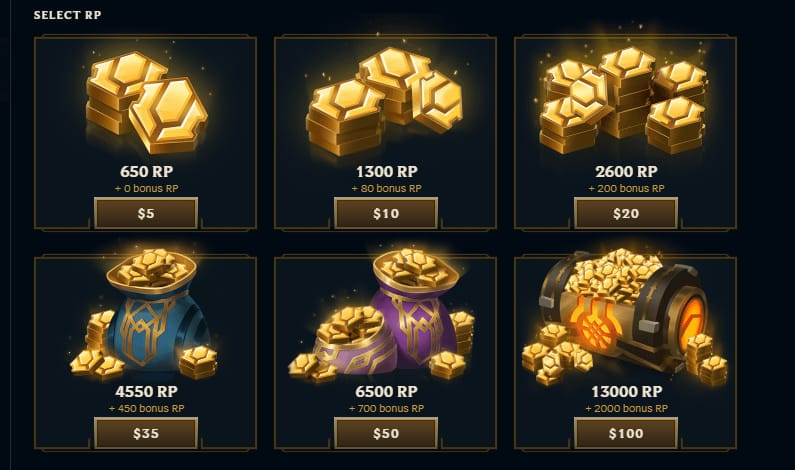
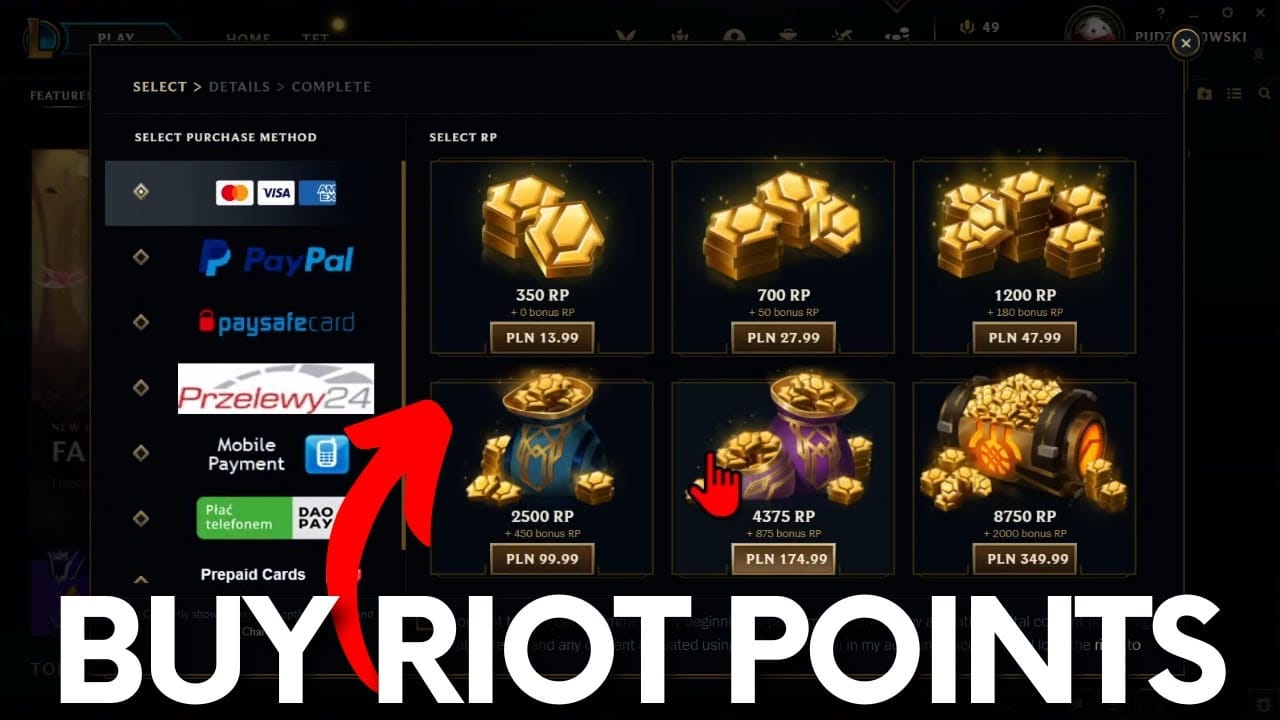
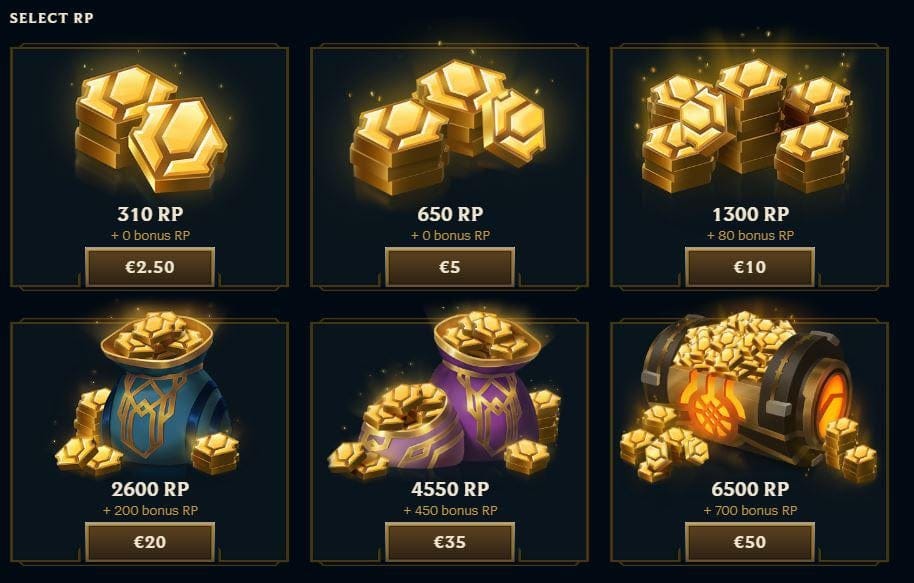
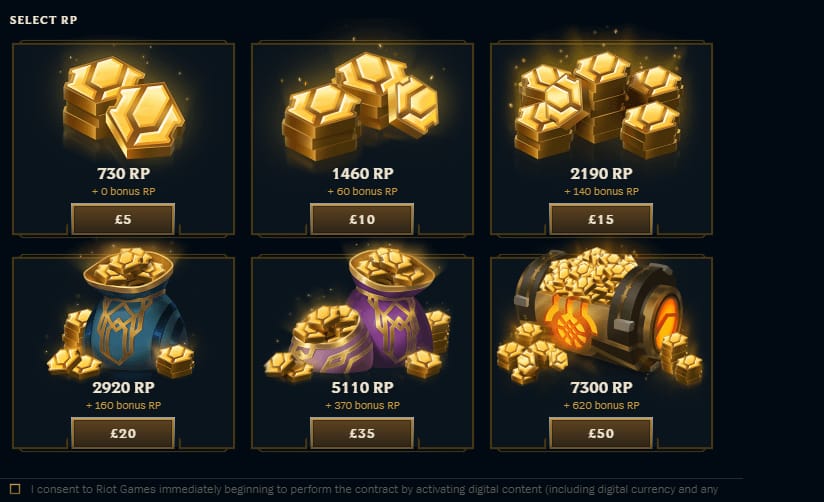
Pull the real numbers and the discount story sharpens fast. On NA, 575 RP runs $4.99, 1380 RP is $10.99, 2800 RP is $21.99, and the chunky 13,500 RP pack sits at $99.99, per the League of Legends Wiki. EUW mirrors that almost beat-for-beat in euros: €4.99, €10.99, €21.99 climbing the same rungs.
Now the bit most price-comparison posts breeze past. The per-RP value isn't flat across tiers. Buying small is the worst use of your money you'll ever make. That $99.99 pack works out to roughly $0.0087 per RP, while the $4.99 starter is noticeably stingier per point (calculated from the wiki tiers, 2026). If you're spending at all, the fat bundles always carry the better value-per-dollar, and that's before any third-party cut even shows up.
| Tier |
NA USD |
EU EUR |
Turkey TRY |
| 575 RP |
$4.99 |
€4.99 |
₺120 |
| 1380 RP |
$10.99 |
€10.99 |
₺250 |
| 2800 RP |
$21.99 |
€21.99 |
₺500 |
| 6500 RP |
$49.99 |
€49.99 |
₺1150 |
Source: League of Legends Wiki RP page (2026)
So a 1380 RP bundle listed around $7–8 on some third-party shop, roughly 25–30% under the $10.99 official price (Eldorado/G2A listings, May 2026)? The gap itself wasn't what made me twitch. The real question is where that $7 comes from. And that's exactly the distinction nearly every guide smudges over.
Why some discounts are real and some get you banned weeks later
Third-party RP runs cheaper for two completely separate reasons, and they sit on opposite ends of the risk scale.
The clean reason is regional pricing. Riot prices RP market by market, and the gaps are big. In Turkey, 575 RP costs ₺120, around $3.50 in equivalent value against the NA $4.99, per Riot Games regional updates. Mexico sits at 95 MXN for the same 575 after Riot's 2026 LATAM adjustment. A seller sourcing genuine Turkish or LATAM-priced codes can hand that saving along honestly. Gift-card bundles surface even lower, with small denominations listing around $3.47–3.48 versus the $4.99 floor (Eneba, May 2026).
The ugly reason is fraud. Some "too cheap" RP is bought on stolen credit cards, then flipped to you at a discount. You get the RP. The charge looks clean for a while. Then the real cardholder disputes it, and Riot's system traces that reversal right back to your account.
And the ban is delayed. A widely-discussed r/riotgames thread laid out the exact pattern: accounts that got RP "out of nowhere," burned it, then ate a ban once the fraudulent charge cleared and reversed (Reddit, 2026). The discount felt fine for days, sometimes weeks. The penalty showed up after the money trail caught it. If you can't say why a price is low, you're not buying a discount. You're adopting somebody else's chargeback.
What Riot's policy actually says, and what it doesn't
Riot's stance is blunt. The Chargebacks article puts it plainly: "You should never have to buy premium currency through a third party. If the third party is cutting you a deal, they're likely not as legitimate as they claim" (Riot Support Chargebacks article, Apr 2026).
Read the money mechanics underneath, though, because that's where the teeth are. Per the same support documentation, a chargeback suspends your account and leaves you on the hook: "If you receive a chargeback after making a third-party purchase, you'll still need to repay the full balance due yourself." So the downside isn't a banned account. It's a banned account plus a bill. That's the lopsidedness players keep underestimating.
Now I'll shove back on the popular narrative. The flat claim that any third-party RP buy is an automatic ban is an oversimplification that just misleads people. Riot's policy goes after fraudulent funding and chargeback abuse, not the act of paying less. The recurring fear in r/leagueoflegends discussion lands on the same spot: stolen cards and chargebacks, never the discount on its own (multiple 2026 threads). The channel isn't what trips the alarm. The payment source is.
Region arbitrage lives in a genuine gray zone, and even though it's not strictly fraud, this is where I'd wave most players off. Buying RP at Turkish prices and trying to spend it elsewhere routinely flops. Region-lock kills the redemption, and Riot's own writing on system exploitation notes that arbitrage attempts trip fraud detection (per Riot Games, 2026). Two quiet snares stack here: gift-card RP codes are region-locked and won't redeem cross-region, and region-priced RP doesn't follow you if you later transfer your account's region. The savings look real until they vanish at the redemption screen.
Riot framed the 2026 regional shakeup simply: "these adjustments are necessary to combat the manipulation we're seeing in the system" (Riot blog, Sep 2026). They're actively bolting the arbitrage gaps shut, which means any saving built on them is fragile by design.
Reading a top-up service before you hand over a card
The choice that shields you most isn't which site. It's which payment method. That's the single biggest safety lever you actually hold, since it caps your downside when something goes sideways.
What I size up before paying anywhere outside the first-party store:
- Price sanity. Against the official baseline above, a 20–30% discount is believable from regional sourcing. A 60–70% "deal" is a fraud flare; that arithmetic only works if somebody else is swallowing the cost.
- Payment exposure. A prepaid or secured method caps your loss at whatever you loaded. Slapping a primary credit card onto an unverified site opens you to fraud disputes and chargeback chains that, under Riot policy, march straight to suspension.
- Sourcing transparency. A seller who explains where its RP or codes come from is doing the one thing fraud rings never do.
- Delivery and verification. Instant-delivery promises stapled to "no questions asked" anonymity are the opposite of comforting. Honest sellers verify. Scams rush.
And the oldest trap still works, mostly because it costs nothing to fall for. "Instant RP generators" and code-giveaway pages are pure phishing. There's no generator. There never was one. The only thing they generate is a harvested login.
On transparency, if you do stack verified third-party routes against official prices, do it out in the open. Full disclosure: this piece is published by VGTopup, itself a top-up platform, so weigh it accordingly and let the neutral price comparison decide. The honest framing is that any third-party option gets measured against the official tiers, not sold as a swap for checking them. You can always start from the League of Legends RP top up baseline and compare outward from there.
Who should bother and who shouldn't, by spend level
The honest answer splits hard depending on how much you drop on the game.
If you're F2P or a light spender, skip third-party RP outright. The community read across the threads is consistent: the saving on one small bundle, a few bucks, never offsets the ban exposure (Reddit consensus, 2026). You'd be gambling an account you've poured hundreds of hours into to pocket the price of a flat white. Stick to the official store. And remember Blue Essence unlocks champions for free anyway. There's no version of this that pencils out for you.
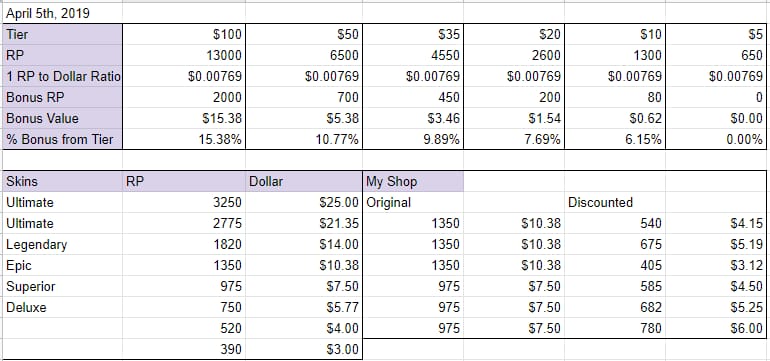
If you're a mid-spender weighing official against third-party value, the call gets tighter but lands in the same place for me. Sure, the effective rate on cleanly-sourced third-party RP can dip toward $0.005–0.006 per RP against the official ~$0.0087 (calculated from wiki prices, 2026). That's a real gap. But it's only real if the funding is clean, and a single chargeback torches years of accumulated savings and sticks you with the bill. Riot's policy plus the documented community cases both point the same way: the official store's reliability cancels out the discount for anyone who's actually invested in their account.
The one crowd with a real, low-risk edge: players genuinely living in a cheaper region, paying their local official price. That's not arbitrage. That's just the price where they are. Turkey stays the cheapest stable market, NA and EU sit higher (per the wiki and regional data, 2026), and Turkish prices on a Turkish account are simply the store behaving as intended.
What I'd do differently next time
I used to treat the headline discount as the whole decision. It isn't. It's the least important variable in the bunch. The order of operations now: check the official tier first, judge the discount's plausibility against it, then decide on payment method and sourcing transparency, never the percentage off. A 25% saving funded by a clean regional code on a prepaid card is a defensible buy. A 65% saving on a primary credit card from some anonymous seller is a delayed ban idling until the charge clears. Same "deal" on the surface, opposite endings.
If a price can't explain itself, treat it as guilty until it does. That one rule would've spared every banned account in those Reddit threads.
Frequently Asked Questions
Can you actually get banned just for buying cheap RP?
Not for the discount itself, only when the RP rides in on a chargeback or stolen card, per Riot Support. The trick is timing. The ban often drops weeks after purchase, once the fraudulent charge clears and the real cardholder disputes it. By then the RP feels "safe," which is exactly why the trap keeps catching people.
Why is third-party RP cheaper than official prices?
Two reasons with opposite risk. Legitimately, regional pricing carves out real gaps; Turkey's 575 RP runs about $3.50 equivalent against NA's $4.99 (per Riot Games, 2026). Illegitimately, the RP was bought on stolen cards and dumped below cost. A 20–30% discount can be the honest kind. Anything far steeper is usually the other kind.
Will region-priced RP work on my account if I bought it cheaper abroad?
Often no. Gift-card RP codes are region-locked and won't redeem cross-region, and Riot's fraud detection flags arbitrage attempts (per Riot Games, 2026). Worse, region-priced RP doesn't transfer if you later swap your account's region, so savings you thought you'd banked can just stop working after a move.
What's the safest payment method for topping up RP?
A prepaid or secured method, because it caps your worst-case loss at whatever you loaded. Putting a primary credit card on an unverified site opens you to fraud disputes and chargeback chains that, under Riot policy, can suspend your account. The payment you pick protects you more than the site you pick.
Are those "free RP generator" sites ever real?
No. There is no RP generator. Those pages exist to harvest your login or shove you through endless surveys. Riot's only source for premium currency is its own store, so any site promising free or auto-generated RP is phishing, and that's the whole story.






Comments