Diamonds, beans, and bonuses before you spend a cent
Diamonds are what you buy. Beans are what creators cash out. They're not the same thing, and that gap is precisely why gifters misjudge their own generosity.
Send a diamond-priced gift and the streamer doesn't pocket a full diamond's worth of value. Gifts convert to Beans for creators at a 1:1 ratio after the platform takes its cut, per Bigo.tv, and that cut is roughly half. On the cash-out side, Beans clear at 210 Beans = $1 USD, according to a Bittopup guide (2025). So a diamond you bought for about $0.019 lands as a sliver of that in the creator's real payout. If your whole reason for topping up is "I want my favorite host to earn," that conversion reality should cool how much you assume a 10,000-diamond gift hands them.
The bonus system is the other half, and honestly it's the half that decides value. Bonus diamonds scale with pack size. First-time buyers can land up to 5x rewards or a flat +250 Diamonds on select web packs, per the official recharge portal. VIP and Noble perks stack on top of size, and new-user exclusive packs show up on third-party storefronts too.
Now the mechanic that quietly trips people: that first-time bonus generally fires once per account, not once per package. Mistime it, dump it on a $9.99 starter, and you've burned your single highest-ROI move on the weakest tier on the board. Bonus diamonds also don't carry the gifting weight you might assume, since the creator-side conversion already devours half before Beans even enter the picture. Hold onto that asymmetry as we hit the cost-per-diamond table. The headline diamond count is a distraction. Effective cost after bonus is the only number worth your attention.
Cost-per-diamond across every 2026 tier
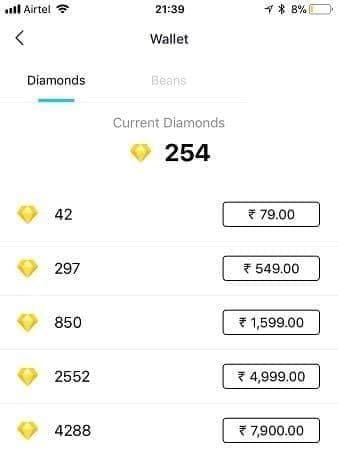
Listed price tells you almost nothing. Cost-per-diamond tells you everything. Here's the official web ladder with the per-unit figures already worked out.
| Diamonds |
USD Price |
Approx $/Diamond |
| 524 |
$9.99 |
$0.0190 |
| 1,620 |
$29.99 |
$0.0185 |
| 5,450 |
$99.99 |
$0.0183 |
| 16,450 |
$299.99 |
$0.0182 |
| 33,030 |
$599.99 |
$0.0182 |
Source: BIGO LIVE Recharge site (2026)
Watch where the curve flattens. The drop from the 524 pack ($0.0190/diamond) to the 1,620 pack ($0.0185) is the single biggest per-unit improvement on the whole ladder, roughly a 3% better rate for stepping up one tier. After that it barely budges. The slide from 5,450 to 33,030 shaves a fraction of a hundredth of a cent. Web packs run from about $0.019 per Diamond at the floor to ~$0.0183 near the ceiling.
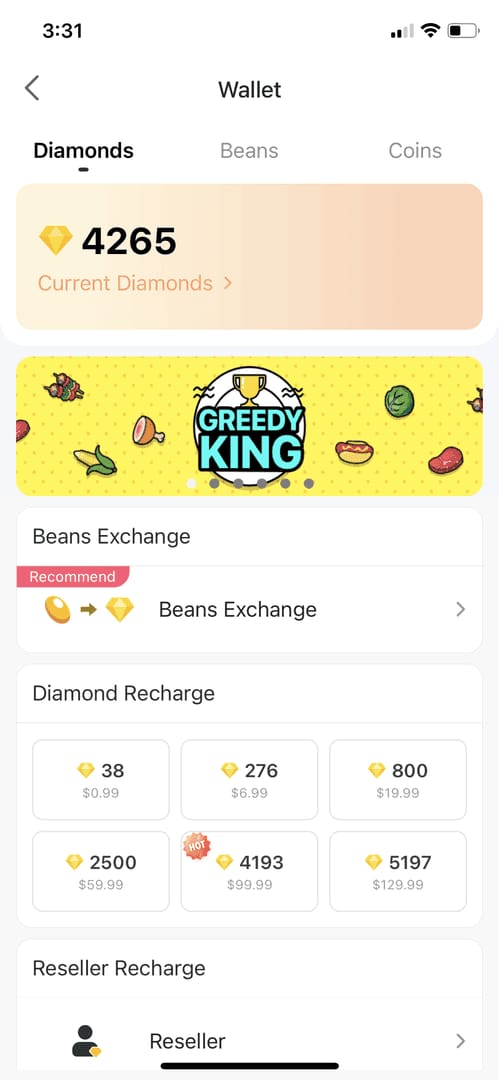
In plain terms: the value sweet spot is the second tier up, not the mega pack. That 1,620-diamond pack captures most of the available discount. Climbing from $29.99 to $599.99 buys you a rounding error in efficiency. You're not getting meaningfully cheaper diamonds, you're just stacking more of them at essentially the same rate. A community guide on Topuplive confirms larger packages consistently edge out smaller ones on per-diamond value across both official and third-party channels, but "edge out" is the operative phrase once you're past that opening jump.
So the contrarian read holds. The "always grab the biggest pack" advice is flat wrong for anyone who won't spend the surplus. The efficiency you pick up after the 1,620 tier is negligible; the cash you sink is not. Which brings us to the channel question, where the real savings actually live, not in pack size but in where you check out.
The 30% app-store tax dwarfs every bonus tier
Change one habit and make it this: stop topping up inside the app. The fee gap between in-app and web recharge is wider than the entire spread between the cheapest and priciest diamond packs.
Buy diamonds through Apple or Google billing and a 30% platform fee rides the transaction, the standard store cut, per a 2026 RevenueCat breakdown. It drops to 15% only for small developers under $1M revenue, which doesn't apply to a platform Bigo's size. That fee doesn't evaporate; it's baked into what you pay or what the host receives. The official portal claims web recharge "saves at least 25% vs other methods," and the reasoning behind that line is exactly the store fee it bypasses.
Community guides peg the real-world delta even steeper. According to a GameBar.gg blog (Nov 2025), buying outside the app can run 20–40% cheaper, citing 5,000 Diamonds landing around $70–85 versus $100–105 through official in-app or store pricing. That's a $20–30 swing on a single mid-size pack, which makes the fraction-of-a-cent differences between tiers look almost quaint.
| Method |
Why it costs what it costs |
Effect on your price |
| In-app (Apple/Google) |
30% store fee baked in (per RevenueCat 2026) |
Highest — avoid for value |
| Official web portal |
No store fee; flat USD packs |
~25%+ cheaper than in-app (per official claim) |
| Verified third-party |
Uses official top-up API, local payment methods |
20–40% off (per GameBar.gg / Enjoygm) |
Source: RevenueCat (2026), BIGO LIVE Recharge site (2026), GameBar.gg (2025)
One more buried cost worth flagging: store billing can layer a currency-conversion markup on top of that 30%, especially when your store region and card currency don't line up. So the in-app price is sometimes uglier than even the headline fee suggests.
This is the most common pitfall in the scene, practically the default reflex. People top up in-app out of pure convenience and silently overpay the platform tax on every single purchase. The fix costs nothing but two extra taps to the web portal. With the channel sorted, the next variable is geography, which quietly reshapes what "best value" even means depending on where you live.
Your "best pack" depends on where your wallet lives
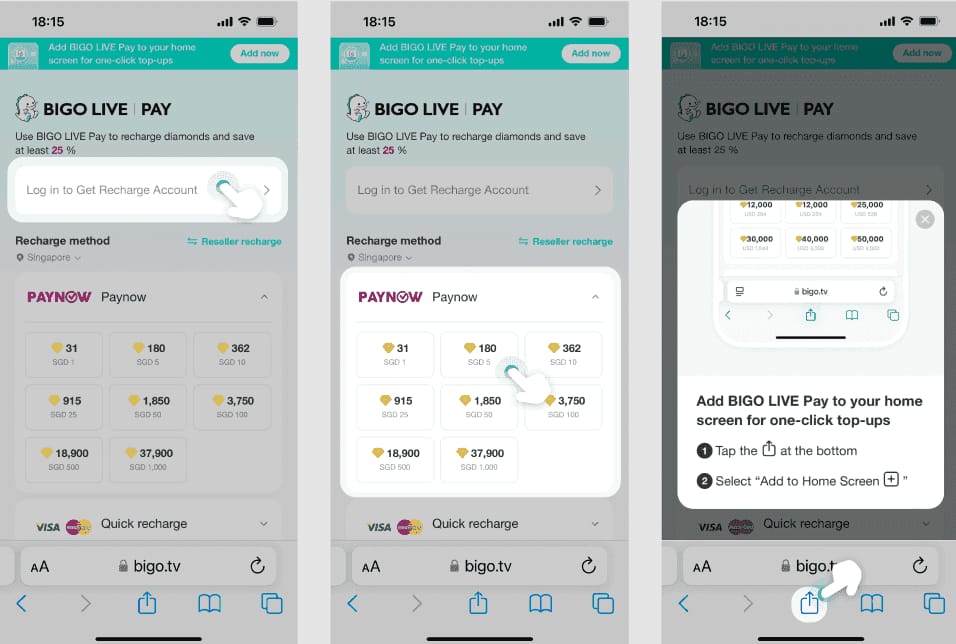
The same diamond pack doesn't cost the same everywhere, and the reason sits in payment infrastructure as much as currency. The official web portal lists flat USD packs, clean and predictable, identical worldwide in dollar terms. But that uniformity can work against you when local payment methods carry conversion fees on USD charges.
Third-party channels swing the other direction. Per multiple 2026 sources including MTCGame and Enjoygm, they support local payment methods across India, Indonesia, the Middle East, and Brazil: UPI, e-wallets, regional cards, local-currency checkout. For a gifter in Jakarta or Riyadh, paying in local currency through a verified channel can dodge the forex markup a flat-USD card charge tacks on. The headline pack price might look identical, yet your effective cost after the bank's conversion spread is not.
So "cheapest" partly hinges on your wallet, not just Bigo's price list. A US buyer with a dollar-denominated card gets the cleanest deal straight from the flat-USD web portal. Someone paying in rupiah, rupees, dirhams, or reais should weigh the local-payment third-party price against the portal's USD figure after their own conversion fee. Sometimes the local-currency route nets out cheaper despite an identical sticker. That regional wrinkle hits some profiles harder than others, which is the right cue to match packs against actual spending behavior.
Match the pack to the kind of spender you are
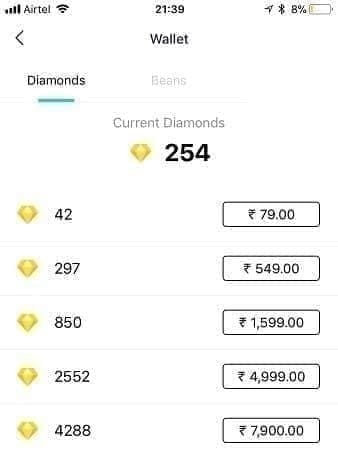
There's no universal best package, and any list that hands you one is hiding the variable that decides everything: how much you'll truly use. Here's the clean split.
Casual viewer, occasional gifts. Buy small web packs and stop. The 524-diamond pack at $9.99 works fine as a casual purchase precisely because you won't waste surplus. The official portal's own positioning steers casual viewers toward small web packs to dodge in-app fees and avoid overspending. Sure, the per-diamond rate is the worst on the ladder, but for someone who tips a host twice a month, the difference between the 524 and 1,620 tier is a couple of cents in efficiency against $20 more out of pocket. Buying a mega pack you'll never drain is the real trap, not the slightly worse unit rate.
Regular gifter, monthly supporter. This is where optimization actually pays. Set the 1,620 tier as your floor, and seriously weigh verified third-party pricing. According to an Enjoygm blog (2026), the regular gifter's playbook is leaning on third-party savings in the 1,000–5,000 diamond range and checking $/diamond to stretch a monthly budget. Their published comparison is steep:
| Diamonds |
Enjoygm Price |
Claimed Official |
Savings % |
| 500 |
$9.19 |
$13.40 |
32% |
| 1,000 |
$18.29 |
$27.00 |
33% |
| 5,000 |
$91.89 |
$135.00 |
32% |
| 10,000 |
$186.88 |
$268.00 |
31% |
Source: Enjoygm blog (2026)
Treat those exact percentages as a vendor's own claim, not scripture. They're a tier5 community figure, and the "claimed official" column runs higher than the flat web-portal prices, so the real savings versus web recharge are slimmer than versus in-app. Still, the direction holds across every source: outside the app, you pay less. Gift every month and that compounding 20–30%-ish saving turns into genuine money.
Heavy supporter, frequent large gifter. Go bulk, but go in eyes open. Per the official portal, heavy supporters should grab 10k+ diamond web or third-party packs for the lowest $/diamond and chase first-time bonuses up to 5x. The catch from the ladder above: past the 1,620 tier, the per-unit rate barely improves, so "lowest $/diamond" is a marginal win. The honest reason to buy big as a heavy supporter is fewer transactions and locking the welcome bonus onto a large base, not a meaningfully cheaper diamond. And don't forget the beans asymmetry: a 16,450-diamond gifting spree converts to far less in the host's actual payout than the count implies, since the platform halves it before Beans, and only then do those 210 Beans clear a dollar.
For full transparency, this piece is published by VGTopup, itself one of the verified third-party top-up channels. So weight the channel advice accordingly, and do the one thing that protects you regardless of who's writing: compare the live price against in-app before committing. Settled on a tier? You can line up a Bigo Live Diamonds top up price against your app-store quote and watch the gap for yourself.
What's likely to shift next, and what to lock in now
Through June 2026, top-up pricing has been quiet. No official patch notes touching diamond costs or bonus rates surfaced, and the portal's prices held steady. That calm won't last forever, and a few levers deserve watching.
First, bonus rates move more often than base prices do. The 5x first-time reward and +250-diamond promos are event-flavored; they rotate across select packs rather than sitting fixed. If you're a fresh account, the smart play isn't waiting for a "better" base price, it's claiming that welcome bonus on a large pack now, since the one-time-per-account multiplier is the highest-leverage spend you'll ever make and there's no promise the 5x tier stays live.
Second, platform fee policy is the wildcard. The 30% store cut is the single biggest swing factor in what you pay, and regulatory pressure on those fees keeps shifting worldwide. If Apple or Google billing economics move, in-app pricing could move with them. The web portal will almost certainly stay the cleaner route regardless, because it never touched that fee in the first place.
Third, the third-party safety question stays genuinely two-sided. Multiple 2026 guides argue verified channels like the major reputable third-parties are safe and cheaper because they run through Bigo's official top-up API. A Buffget article warns of ban or fulfillment risk with unverified sellers. Both can be true at once. My read: the official web portal is the safest default and the right answer for anyone who wants zero ambiguity. A verified third-party is a legitimate value play once you've confirmed it rides official top-up rails and you're paying through a channel you trust. The danger isn't "third-party" as a category, it's anonymous, unverified sellers. Don't hand your Bigo ID to anywhere you can't vouch for.
So lock it in: web over in-app, the 1,620 tier as your value floor, the welcome bonus on your first large buy. Everything past that is optimization at the edges.
Frequently Asked Questions
Does the first-time bonus reset if I switch from a small pack to a big one later?
No. The welcome bonus is generally a one-per-account event, not one-per-package, per the official recharge portal. That's the trap: claim it on a $9.99 starter and you can't re-trigger the up-to-5x reward on a larger pack down the line. Brand-new account? Your single most valuable move is timing that first purchase to your biggest realistic pack while a 5x or +250 promo is live.
If I pay in rupees or rupiah, is the flat-USD web pack still the cheapest option?
Not always. The portal's USD packs are identical worldwide in dollar terms, but your bank's conversion spread on a USD charge can quietly pad the cost. Per 2026 regional sources, verified third-party channels support local payment methods in India, Indonesia, the Middle East and Brazil, so a local-currency checkout sometimes nets out cheaper than the same pack billed in dollars, even at an identical sticker. Compare after your conversion fee.
How much does a creator actually earn when I gift 1,000 diamonds?
Far less than 1,000 diamonds' face value. Gifts convert to Beans at 1:1 after the platform takes roughly half, per Bigo.tv, and Beans cash out at 210 Beans = $1, per Bittopup (2025). So the downstream payout is a fraction of what you spent, worth knowing before assuming a big gift translates into big host income. Bonus diamonds don't dodge this either.
Are the bigger mega packs ever a mistake to buy?
For casual viewers, often yes. Past the 1,620-diamond tier, per-diamond cost barely improves; the official ladder slides from ~$0.0185 to ~$0.0182 across the entire top of the range. Won't spend the surplus? You're freezing cash for a rounding-error discount. Mega packs only earn their keep for genuine frequent gifters who'll actually burn the balance and want fewer transactions.
How do I verify I'm getting the real current price before I buy?
Pull up the official web portal price for your exact diamond count, then set it side by side with your in-app quote and any verified third-party channel, including the published per-diamond rate. Prices held stable through June 2026 with no official changes flagged, but bonus promos rotate, so confirm whether a first-time or VIP bonus is live on your chosen pack at checkout rather than trusting the rate from any guide, this one included.







Comments