
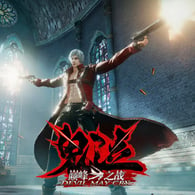
Devil May Cry: Peak of Combat — The Complete Guide to Stylish Mobile Demon Hunting
Introduction & Quick Facts
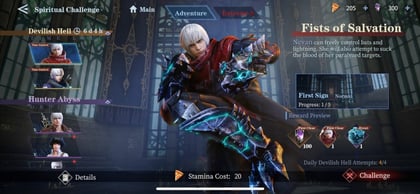
Devil May Cry: Peak of Combat is the official mobile entry in Capcom's legendary character action franchise, developed by NebulaJoy under direct supervision from Capcom's core DMC team. It distills the series' signature combo-driven, Stylish-Rank-chasing combat into a touch-optimized package that runs on mid-range Android and iOS hardware, while preserving the franchise's gothic-industrial visual identity, weapon-switching depth, and roster of fan-favorite demon hunters spanning DMC3, DMC4, DmC, and DMC5.
The game launched globally in January 2024 after a long regional rollout that began in Asia. It is free-to-play with gacha-based character and weapon acquisition, but skill expression remains the dominant performance vector — a player who masters timing, weapon cancels, and rank maintenance will out-clear a whale who button-mashes. That balance, plus official Capcom involvement, is why it draws both veteran SSS-rank chasers and curious mobile action newcomers.
Below is the at-a-glance summary before we dig into mechanics, roster, modes, and strategy.
| Field | Detail |
|---|---|
| Title | Devil May Cry: Peak of Combat |
| Publisher | NebulaJoy |
| Developer | NebulaJoy (under Capcom supervision) |
| Platform | Android / iOS |
| Region | Global |
| Genre | Action RPG / Character Action |
| Monetization | Free-to-play with gacha, battle pass, top-up currency |
| Language Support | English, Japanese, Korean, Simplified & Traditional Chinese, Arabic |
| Launch (Global) | January 2024 |
| Official Website | nebulajoy.com |
What is Devil May Cry: Peak of Combat?
Peak of Combat is a 3D real-time action RPG built around the franchise's defining loop: enter an arena, chain varied attacks, dodge-cancel into new strings, swap weapons or characters mid-combo, and climb the Stylish Rank meter from D ("Dismal") up through C, B, A, S, SS, and SSS ("Smokin' Sexy Style"). Each stage scores you on that rank in addition to clear time and damage taken, and the highest reward tiers are gated behind sustained SSS performance — meaning the game rewards mechanical mastery rather than raw stat inflation alone.
Unlike most mobile action games that simplify everything into a single auto-attack and three cooldowns, Peak of Combat preserves the granular toolkit of console DMC. A single character has a basic combo string with branch inputs, an aerial launcher, a dodge with i-frames, a weapon-specific special, an ultimate skill, a switch-cancel into another team member, and Devil Trigger activation. Stylish Rank actively decays when you repeat the same input, encouraging you to rotate through your entire kit instead of spamming the strongest move.
The target audience splits into three camps. First, series veterans who played DMC3/4/5 on console and want a portable, lower-commitment way to chase combos during commute or downtime. Second, mobile action RPG players who are tired of auto-battlers and want something with a genuine skill ceiling. Third, gacha collectors drawn to the character variants — Dante alone has multiple summonable forms (Sin Devil Trigger Dante, DmC Dante, classic DMC3 Dante, etc.), each playing meaningfully differently. People care about Peak of Combat specifically because it is one of the very few mobile games where Capcom directly licensed and supervised the combat feel, so the animations, hit-stop, and cancel windows actually resemble the source material rather than a generic action skin.
Core Gameplay & Features
The systems stack deep. Here are the pillars that define moment-to-moment play and long-term progression:
- Stylish Rank scoring (D → SSS) that rewards combo variety, dodge timing, and taunts while punishing repetition and damage taken.
- Three-hunter team composition with real-time hot-swapping mid-combo, enabling Devil-May-Cry-5-style "switch cancel" extensions and synergy chains.
- Multi-weapon loadout per character, with weapon-specific movesets — Yamato gives Vergil teleport slashes, Rebellion gives Dante launcher combos, Red Queen gives Nero Exceed revs, etc.
- Devil Trigger transformations unique to each variant, granting temporary damage, speed, super-armor, and movelist changes.
- Gacha summons across Permanent, Legendary, and limited SSS banners for character variants, weapons, and cosmetic skins.
- Memory Corridor story campaign with chapters playable on Human, Devil Hunter, Son of Sparda, and Dante Must Die difficulties.
- Bloody Palace endless tower for pure score and survival competition with global leaderboards.
- Co-op raids and PvP modes including Nightmare Game bosses, Speed Elimination, and Boss Hunt scoring.
- Seven skill nodes per character unlocked and upgraded with Red Orbs and character-specific Soul Crystals.
- Weapon awakening and rank-ups consuming Crimson Scales and duplicate weapon shards to raise power, physique, crit, and break stats.
- Elemental affinities (Physical, Fire, Ice, Lightning, Holy, Demonic) that shift damage multipliers per boss week.
- Auto-battle and aim-assist toggles for low-stakes farming, with full manual control preserved for ranked content.
Combat depth in detail
The combat engine is genuinely the selling point, so it deserves unpacking. Every character has roughly the same input grammar: Attack, Heavy/Branch, Dodge, Skill 1, Skill 2 (often a weapon special), and Ultimate. What changes is how those inputs interact. A Dante variant might branch his ground combo by tapping Heavy at the third hit to swap from Rebellion sword to Cerberus nunchaku mid-string, while a Vergil variant uses Heavy to teleport behind the target for a Judgment Cut follow-up. Mastery is recognizing each variant's cancel windows — most basic-attack hits can be canceled into a dodge after the active frames, and the dodge itself can be canceled into a skill, which can then chain into a team-swap that resets cooldowns of the outgoing fighter.
Stylish Rank mechanics
Rank rises with damage dealt + input variety, and falls with: (1) using the same exact attack three times in a row, (2) taking damage, (3) standing idle, (4) missing whiffed attacks against air. Taunting (a dedicated button) gives a one-time rank boost but locks you in place for ~1 second, so it is a risk-reward tool used between enemy waves or right before a boss break window. SSS rank multiplies Red Orb gain by up to 2x and is required for three-star mission clears that unlock the highest-tier reward chests.
Progression layers
Power comes from five overlapping systems: character level (capped by player account level), skill node investment (Red Orbs), weapon level + rank-up (Crimson Scales + duplicates), equipment/relic sets with substat rolls, and character "Awakening" which unlocks new passive nodes after clearing specific high-difficulty Memory Corridor missions. Whales accelerate the gacha layer but cannot skip Awakening clears, which keeps mechanical play relevant at the ceiling.
Pro Tips & Strategy
Beginner (Day 1–7)
- Finish the entire main story on Human difficulty before touching gacha pulls. The campaign hands you a free SR Dante and SR Lady plus enough summon currency to make informed banner choices once you understand which playstyle clicks.
- Bind the dodge button comfortably. Default placement is fine for most, but resize it larger and pull it closer to your right thumb in Settings → Controls. Dodge i-frames are generous (~12 frames) but useless if your thumb has to travel.
- Learn one character deeply before chasing the next. Pick whichever starter feels best (Nero is the most forgiving, Dante the most expressive, Vergil the most punishing) and grind their skill tree to max before spreading resources.
- Always spend stamina on the daily Slot of Slaughter rotation — it gives weapon upgrade mats, Red Orbs, and character shards on a fixed weekday schedule. Missing days compounds badly.
- Claim every mailbox reward and login bonus daily. Limited summon tickets expire after 30 days in some events.
Intermediate (Day 7–30)
- Build a three-hunter team with role coverage: one main DPS, one burst/finisher, one utility (debuffer, healer-equivalent, or break specialist). Avoid running three identical archetypes — switch-canceling between similar movesets wastes the rank-variety bonus.
- Use team swaps offensively, not defensively. Swapping a character out resets their skill cooldowns. Burn Skill 1 + Skill 2, swap, burn the next hunter's skills, swap again — you can rotate three full ultimates in under 15 seconds.
- Match elemental affinity to the weekly boss. A 20% element advantage often beats a 1000-power gear upgrade. Check the Boss Hunt info panel before locking in your team.
- Don't rank-up duplicate weapons immediately. Save duplicates until you have confirmed which weapon you'll actually run long-term — rank-up materials are not refundable.
- Run Bloody Palace at least 3 floors per day even if you can't beat your record. Daily participation rewards compound into a full SSR weapon ticket monthly.
- In Memory Corridor, three-star runs are gated by Stylish Rank, not just clear. If you're clearing but missing stars, slow down, vary inputs, and avoid getting hit — raw DPS isn't the issue.
Advanced (Day 30+)
- Practice "Jump Cancel" loops — most characters can jump-cancel a launcher hit, attack in air, dodge-cancel the air attack to reset jump, and repeat. This is the highest sustained-DPS pattern in the game and is mandatory for top-tier Bloody Palace runs.
- Time Devil Trigger activation to the boss's exposed/break state, not as soon as it's available. DT duration is short and its damage multiplier multiplies break-state damage that's already inflated.
- Substat re-rolls on equipment matter more than main stat at endgame. Aim for Crit Rate, Crit Damage, and weapon-specific Break stat on offensive pieces; HP% and Damage Reduction on defensive.
- Save premium currency for limited SSS banners with a guaranteed rate-up character, not the Permanent pool. The Permanent banner's value-per-pull is roughly half the limited rate-up.
- For PvP Speed Elimination, prioritize hunters with multi-target screen-clear ultimates (e.g., V-style summon variants, certain Trish builds). Single-target burst loses to AoE on clear time.
- In Nightmare Game co-op raids, assign roles in pre-lobby chat. One player runs a Break-stat specialist to trigger the stun phase faster — the team's total damage during a single stun phase often determines clear tier.
- Track event end dates in a personal calendar. Vergil's Soul Realm, weapon skin events, and anniversary stat-awakening pages all expire, and re-runs can be 6+ months apart.
Characters & Roles
Below is a snapshot of the headline demon hunters and what they're known for in-game. Each name represents a base hunter with multiple gacha variants that play differently — for example, an SSR Dante version may be a balanced all-rounder while a limited SSS Dante shifts toward Sin Devil Trigger burst.
| Hunter | Primary Role | Signature Trait |
|---|---|---|
| Dante | Balanced DPS / Stylist | Multi-weapon swapping mid-combo; highest skill ceiling and rank potential |
| Vergil | Burst DPS / Assassin | Yamato teleport + Judgment Cut openers; punishes bosses in stun windows |
| Nero | Bruiser / Beginner-friendly | Red Queen Exceed revs; Devil Bringer/Devil Breaker grabs and pulls |
| Lady | Ranged DPS | Kalina Ann rockets and submachine guns; safe pressure from distance |
| Trish | Lightning Speedster | Sparda sword + electric AoE; strong in PvP screen-clear |
| V | Summoner / Controller | Controls Griffon, Shadow, and Nightmare; complex but high-utility |
| Lucia (variant) | Hybrid DPS | Throwing-blade combos; mobility-focused |
Each hunter has up to seven skill nodes — typically two passives, two active skills, one ultimate, and two unlockable Awakening nodes — and 15 weapon categories spread across the roster (Yamato, Rebellion, Devil Sword Dante, Red Queen, Blue Rose, Kalina Ann, Cerberus, Beowulf, Faust hat-revolver hybrid, Sparda, Coyote-A, etc.).
Game Modes Deep Dive
Peak of Combat layers single-player, co-op, and competitive content so that no single mode is the only daily grind.
| Mode | Player Count | Reward Focus | Difficulty Tier |
|---|---|---|---|
| Memory Corridor (Story) | Solo | Red Orbs, character shards, story unlocks | Human → Dante Must Die |
| Bloody Palace | Solo endless | Leaderboard rewards, monthly SSR tickets | Scales infinitely |
| Slot of Slaughter | Solo daily | Weapon/skill upgrade materials | Fixed by weekday |
| Realm Conqueror | Solo endless | Crimson Scales, awakening shards | High |
| Vergil's Soul Realm | Solo event | Limited skins, premium currency | Very high |
| Nightmare Game | Co-op (3p) | Raid boss drops, weekly chests | High–Extreme |
| Speed Elimination | PvP async | Ranked rewards, season skins | Competitive |
| Boss Hunt | PvP scored | Top-percentile crystals, summon tickets | Competitive |
Memory Corridor
The story spine. Chapters retell key story beats from across the DMC timeline through a "memory" framing device, which is how Capcom and NebulaJoy justify mixing DMC3 Vergil, DMC5 Nero, and DmC Dante in a single roster. Each chapter has 3–5 sub-missions plus a chapter boss, and each sub-mission can be cleared on four ascending difficulties for separate three-star reward tracks. Dante Must Die difficulty introduces Doppelganger enemies that copy your moveset, forcing you to actually defend rather than mash.
Bloody Palace
The traditional DMC endless arena returns. Floors increase in enemy density and resistance, with mini-bosses every 10 floors and major bosses every 50. There is no stamina cost to enter, but Red Orb and currency drops only credit once per day from your best run. Top global leaderboards reset monthly, and clearing milestone floors (50, 100, 150, 200…) gives permanent profile titles.
Nightmare Game co-op
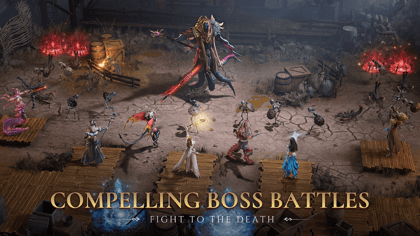
Three-player real-time raids against franchise bosses with inflated HP pools (Phantom, Beowulf, Nevan, Berial, Cavaliere Angelo, and more). Each player picks a different lead hunter — duplicates are allowed but discouraged because of overlapping cooldown timing. Clears reward boss-specific materials needed for the highest weapon ranks.
PvP modes
Speed Elimination pits you against an asynchronous mirror of another player's defensive team, scored on how fast you clear three waves. Boss Hunt gives all participants the same boss for a fixed window and ranks players by damage in a single attempt — pure burst-damage optimization. Neither mode has direct real-time PvP combat against another human (the franchise's combo system doesn't translate well to laggy 1v1), which sidesteps the usual mobile-PvP balance complaints.
Endgame & Progression Loop
After the main story is cleared and your first few characters hit account-cap level, the daily/weekly loop stabilizes around: dailies (Slot of Slaughter + story stamina burn + login) → weeklies (Nightmare Game raids + Bloody Palace milestone + Realm Conqueror reset) → event push (whatever limited event is live) → banner planning (saving toward the next limited SSS).
The single biggest endgame power source is Character Awakening. Each character has an Awakening track gated behind specific high-difficulty Memory Corridor clears with that character in the lead slot. Awakening unlocks two passive nodes that often fundamentally change the character — adding super-armor to a skill, granting an extra Devil Trigger charge, or converting a skill's element type. You cannot buy Awakening progress; only mechanical clears unlock it, which is the game's main retention hook against pay-to-win drift.
Weapon mastery is the second pillar. Each weapon has a mastery track separate from its level, advanced by using that weapon to land specific actions (e.g., 1,000 air combo hits, 500 perfect dodges into counter, 100 SSS-rank finishes). Mastery rewards include unique combo extensions and small permanent stat boosts — meaning even a free starter Rebellion sword, fully mastered, outperforms a never-mastered SSR weapon in skilled hands up to a certain point.
The third pillar, relic/equipment sets, follows familiar mobile RPG conventions: six slots, set bonuses at 2-piece and 4-piece, randomized substats, daily/weekly material caps. Roll Crit Rate to roughly 60% and Crit Damage to 150%+ before pivoting to break or elemental damage substats.
Top-Up & Recharge
Peak of Combat's premium currency (commonly called Red Orbs for in-game soft currency and a separate hard currency used for summons and the shop) is purchased through in-app purchases on Google Play and the App Store, or through approved third-party top-up portals that credit your account by linking your in-game UID. Players typically top up to pull on limited SSS banners, secure the monthly and seasonal battle passes (which have very high value-per-dollar compared to direct currency purchase), and unlock cosmetic weapon and character skins from rotating shops. UID-based top-up is the standard global flow: you open the in-game profile, copy your numeric UID and server, and submit it during the recharge order. Our site offers fast top-up and recharge for Devil May Cry: Peak of Combat via UID. Always confirm the publisher's official channels on the NebulaJoy website before linking your account anywhere outside the app stores.
Frequently Asked Questions
Q: Is Devil May Cry: Peak of Combat free-to-play?
A: Yes. The full story campaign, Bloody Palace, co-op raids, and PvP are accessible without spending. Spending accelerates character/weapon acquisition through gacha and unlocks cosmetic skins.
Q: Is it pay-to-win?
A: Partially. Spenders pull stronger character variants and max weapons faster, but Stylish Rank scoring, Awakening clears, and Bloody Palace leaderboards reward mechanical skill that cannot be bought. Top global players are almost always skilled, not just whales.
Q: Does it require an always-online connection?
A: Yes. Even solo story missions require an active connection because progression and inventory sync to NebulaJoy's servers.
Q: How is it related to Capcom's mainline DMC games?
A: It is officially licensed and supervised by Capcom's DMC team. Characters, weapons, bosses, and music are drawn directly from DMC3, DMC4, DmC, and DMC5. The story is told as standalone "memories" rather than a numbered sequel.
Q: Can I play with a controller?
A: Controller support exists on both Android and iOS for most mainstream Bluetooth controllers, though the touch UI is the primary supported interface and some menus still require taps.
Q: How big is the install?
A: Initial download is moderate (a few GB) with substantial in-game data downloads on first launch and after major patches. Budget ~10 GB of free storage to be safe.
Q: Which character should a new player main?
A: Nero is the most forgiving (Red Queen has wide, easy-to-confirm combos and Devil Bringer grabs are huge for rank). Dante has the highest ceiling but takes the longest to feel rewarding. Vergil is high-damage but unforgiving — every whiffed Judgment Cut wastes a long cooldown.
Q: What languages are supported?
A: English, Japanese, Korean, Simplified Chinese, Traditional Chinese, and Arabic, with full UI and subtitle coverage. Voice acting is available in multiple languages depending on character and event.
Q: Are there cross-server or cross-region restrictions?
A: The global release is unified for most regions, but server clusters may be split (e.g., Asia, Americas, Europe, MENA) for matchmaking latency. PvP and co-op typically match within your server cluster.
Q: How often does new content release?
A: Major content patches — new character variants, story chapters, weapon banners, and limited events like Vergil's Soul Realm — typically arrive on a roughly monthly cadence, with smaller event rotations weekly.
Q: Can I refund a wrong gacha pull?
A: No. All summons are final once confirmed. Always double-check the active banner and your currency type before pulling.
Q: Does taunting actually matter?
A: Yes. Taunt is a real Stylish Rank booster and an SSS-chaser tool, especially against bosses with telegraphed slow attacks where you have a free second mid-fight. Ignoring it caps your scoring potential.
Verdict
Devil May Cry: Peak of Combat is the closest thing to a real, skill-expressive character action game on mobile. If you grew up on DMC3 SSS-chasing or DMC5 switch-cancel routes, this is the only mobile title that respects that lineage instead of reducing the franchise to an auto-battler skin. If you're a mobile action RPG player burned out on gacha grinds where mechanical input doesn't matter, the Stylish Rank system and Awakening gating give you a genuine reason to improve. And if you collect character variants, the gacha pool's roster depth across multiple DMC eras is hard to match anywhere else.
It is not for everyone. Players who refuse always-online games, who dislike gacha entirely, or who want a one-and-done story experience without daily logins should look elsewhere — Capcom's console DMC catalog still serves them better. Players on very old phones may also struggle with frame consistency in dense co-op raids. But for the target audience — mobile-friendly action fans who want combos, swaps, transformations, and a real performance ceiling — Peak of Combat earns its place as a long-term daily driver, and the franchise's signature smokin' sexy style genuinely survives the transition to a touchscreen.