

Ragnarok M: Classic: The Complete Guide to Gravity's Global Revival of Classic Ragnarok Online
Introduction & Quick Facts
Ragnarok M: Classic is Gravity Interactive's faithful mobile-first reimagining of the original Ragnarok Online's pre-renewal era, engineered specifically for global audiences who grew up grinding Porings in Prontera fields and who still measure MMORPG quality by the depth of its job tree, not the size of its gacha banner. Unlike the broader Ragnarok M family of titles that have iterated heavily on auto-combat conveniences and renewal-era systems, Classic explicitly leans into the 2D sprite aesthetic, the six-into-twelve job progression, the Zeny-only economy, and the persistent open-world structure that made the 2002 PC original a genre-defining release.
Built for Android and iOS with cross-platform compatibility in mind, the game launched globally under English as the primary language with additional localization layers for Arabic, Japanese, Korean, and Chinese-speaking players. Every system — equipment refinement, card slotting, MVP hunting, vending economy, and the War of Emperium guild siege — is designed to reward time invested, social coordination, and economic literacy rather than premium spending. That positioning makes it one of the most pure-blooded "classic" experiences currently available on mobile.
This guide breaks down what the game is, how its systems interlock, what to prioritize at each phase of progression, and how to plan your Zeny economy efficiently across the early, mid, and late game. Whether you are a returning veteran chasing nostalgia or a newcomer curious about why this franchise still has such a devoted following, the sections below cover everything you need to start strong.
| Field | Details |
|---|---|
| Title | Ragnarok M: Classic |
| Publisher | Gravity Interactive |
| Developer | Gravity Co., Ltd. |
| Platform | Android, iOS |
| Region | Global |
| Genre | MMORPG (Classic / Pre-Renewal) |
| Launch | September 2025 |
| Languages | English, Arabic, Japanese, Korean, Chinese |
| Monetization | Cosmetic-leaning, Zeny-only gear economy |
| Official Website | www.gravity.co.kr |
What is Ragnarok M: Classic?
Ragnarok M: Classic is, at its core, an attempt to capture the "first six months of Ragnarok Online" feeling and deliver it on a phone. That means a strictly capped, deliberately paced progression curve, a world where Zeny actually matters because every refinement, potion, and card investment is paid for in-game, and a player economy that lives or dies on vending stalls and player-to-player trade rather than developer-set NPC sinks.
The game uses the original 2D sprite art direction — characters, monsters, and skill effects are rendered in the same flat, animated pixel style that defined the franchise's identity — while the world maps are reconstructed in the classic top-down 3/4 perspective with 3D environmental polish around the edges. Cities like Prontera, Geffen, Payon, Morroc, Alberta, Izlude, and Al de Baran appear in their iconic layouts, and dungeons such as Glast Heim, Pyramid, Sphinx, Orc Dungeon, and Clock Tower are all present as endgame farming and MVP locations.
The target audience splits into three clear groups. First are franchise veterans returning for the pre-renewal formula they have not seen properly preserved on mobile before — the people who care about hit and flee formulas, about VIT-DEF reduction tables, and about Aspd potion stacking. Second are MMORPG players burned out by aggressive monetization who want a title where capital is earned through play rather than purchase. Third are mobile players curious about a game that runs idle/offline farming systems alongside genuinely deep theorycrafting, party-based dungeon content, and large-scale PvP.
Why people care boils down to identity preservation. Gravity has experimented widely with the Ragnarok IP — Eternal Love, Origin, Landverse, X — and each entry tweaked the formula. Classic positions itself as the version that does not tweak. The skill trees, stat allocations, equipment slots, refinement curves, and card system are designed to feel like the original, with quality-of-life additions (auto-pathing, offline farming, mobile UI) layered on top rather than replacing the underlying math.
Core Gameplay & Features
The gameplay loop of Ragnarok M: Classic is built on stacking smaller systems on top of one another so that every hour invested has multiple parallel returns. Here are the headline mechanics you will be interacting with constantly:
- Six-into-twelve job progression — Start as a Novice, branch into one of six first jobs at Level 10, then transition into a second job around Level 40, with each path offering distinct combat identity.
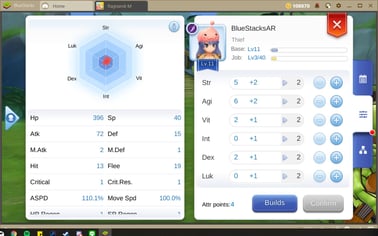
- Stat point allocation — Manually distribute points across STR, AGI, VIT, INT, DEX, and LUK; there are no auto-builds, and respec costs make planning matter.
- Skill tree investment — Each job has a finite skill point pool requiring deliberate choices between offensive ultimates, utility, and party support.
- Open-world farming — Maps have specific monster spawns optimized for level brackets, drop tables, and EXP-per-minute rates that you will memorize over time.
- Card system — Monsters have a small chance to drop cards that slot into weapons, armor, headgear, garments, footgear, accessories, and shields, with each card providing build-defining bonuses.
- Equipment refinement — Push gear from +0 up to +15 through a refinement system where Classic's variant promises safe refines (no break/downgrade on supported tiers) — this is a major economic sink.
- MVP boss hunts — Map-specific super-bosses spawn on timers and drop the rarest cards (Doppelganger, Maya, Eddga, Mistress, etc.), forming the apex of PvE.
- Player-driven vending economy — Set up a stall in major cities to sell loot, cards, and consumables, with prices entirely determined by supply and demand.
- Offline Battle Mode — Park your character at a chosen farming spot and earn EXP and loot while logged off, capped daily but invaluable for working players.
- Monthly Pass (free perpetual) — Daily login distributes EXP buffs, drop-rate boosts, and cosmetic items without paywall.
- War of Emperium — Weekly large-scale guild-versus-guild castle siege where alliances clash for territorial control and exclusive God Item materials.
- PvP arenas and guild dungeons — Smaller-scale competitive and cooperative content for daily engagement outside of WoE windows.
Job Progression in Depth
Job progression is the spine of the entire game. Every Novice starts in the Training Grounds, learns basic attack and movement mechanics, and reaches Job Level 10 within roughly an hour of focused play. At that point you choose between Swordsman (frontline tank/melee), Mage (elemental nuker), Archer (ranged DPS with status arrows), Acolyte (healer/support with light melee options), Merchant (utility/economy specialist with surprisingly strong farming output), and Thief (high-mobility melee with dodge stacking and poison).
Each first job has its own training regimen. Swordsmen grind Wolves and Argiopes for their job change quest. Mages chase Cultists in Geffen Tower. Archers test their precision in Payon Cave. Acolytes complete a pilgrimage across all major towns. Merchants pay a Zeny fee in addition to the quest. Thieves descend into the Cube Room beneath Morroc. These quests are not just gates — they introduce the cultural texture of each class lineage.
Second job transitions around base level 40 / job level 40 unlock the iconic specialized roles: Knight (Bash/Pierce/Bowling Bash DPS), Crusader (Holy tank with Shield Boomerang), Wizard (Storm Gust/Meteor Storm AoE caster), Sage (anti-magic hybrid with autocast utility), Hunter (trap-and-shoot ranged DPS with falcon), Bard/Dancer (party buff specialists), Priest (the gold-standard healer/buffer with Lex Aeterna and Sanctuary), Monk (asura-strike burst caster who punches at 30,000 damage), Blacksmith (forge specialist and Mammonite farmer), Alchemist (homunculus owner with potion creation), Assassin (dual-dagger or katar critical builder), and Rogue (steal-and-strip specialist).
Stats, Skills, and the Math Underneath
Pre-renewal Ragnarok math is what separates the game from most modern MMORPGs. Damage formulas factor in weapon attack, refinement bonuses, card multipliers, elemental advantages against monster races and properties, size modifiers, and the target's hard defense (subtractive) and soft defense (subtractive at a fixed rate). Hit rate and flee rate are calculated against the difference between your DEX and the target's flee, and your AGI plus level versus the target's hit. These numbers are not abstracted — they are visible in your status window and they govern every encounter.
This means stat allocation is a build commitment. A Hunter pushing pure DEX/AGI is optimizing for double strafe damage and attack speed. A VIT-Knight is optimizing for HP pool and Endure uptime in WoE. A high-INT Wizard is sacrificing survivability for nuke ceiling. Misallocating points early means slower kills, worse drops, and slower farming — and the reset system has real cost, so most veterans plan their full curve before they hit Job 10.
Card and Refinement Economy
Cards are the single most defining endgame system. Every monster has roughly a 0.01% to 0.02% drop chance for its unique card, and the value scale is enormous. A common Andre Card (slotted into a weapon for +20% damage versus Plant race) might cost a few hundred thousand Zeny. A Doppelganger Card (+10% ASPD) or a Maya Card (50% reflect on garment) can command tens of millions or more depending on server economy. Hunting cards is a multiplier game — you stack high drop rate gear, EXP/JEXP buffs, and Monthly Pass bonuses, and grind for hours.
Refinement is the other major Zeny sink. Equipment upgraded from +0 to +10 carries meaningful stat increases (additional ATK on weapons, additional DEF on armor pieces), and Classic's refinement system is designed without random breakage on safe tiers, which dramatically changes the economic flow. Players invest accumulated Zeny into ore (Phracon, Emveretarcon, Oridecon, Elunium) and gradually push their gear ceiling rather than gambling against high-loss probability curves.
War of Emperium and Endgame
War of Emperium (WoE) is the apex social activity. Held on scheduled weekly windows, guilds attack castle maps trying to break each defender's Emperium — a crystalline structure inside the throne room of each castle. Holders earn exclusive treasure boxes with rare cards and God Item materials (used to forge Mjolnir, Sleipnir, Megingjard, Asprika, and the Brisingamen). WoE is positional, communication-driven, and demands specific build archetypes (high VIT tanks, Asura-Strike Monks, Storm Gust Wizards, Devotion Crusaders, Pneuma-spamming Priests). Casual players can participate; competitive guilds plan rosters down to individual gear pieces.
| System | Primary Currency Sink | Main Reward |
|---|---|---|
| Refinement (+0 to +15) | Zeny + Oridecon/Elunium | ATK / DEF stat scaling |
| Card Hunting | Time + drop-rate gear | Build-defining slot bonuses |
| MVP Boss Hunts | Party coordination + buffs | Rare cards + crafting materials |
| Vending Economy | Listing time + market knowledge | Zeny accumulation |
| War of Emperium | Guild membership + WoE gear | God Item materials + castle drops |
| Offline Battle Mode | Idle time | Steady EXP and trash loot |
Pro Tips & Strategy
The following tips are organized by player phase. Treat them as a sequenced checklist — most veterans run essentially this same playbook on a fresh server.
Beginner Tips (Level 1 to 40)
Plan your full build before allocating stats. Decide whether your second job will be a high-DEX Hunter, a VIT Knight, a pure-INT Wizard, or otherwise, and reverse-engineer your stat curve from the second-job target. Misallocated points cost real Zeny to reset.
Complete every first-time map clear bonus. Many maps grant one-time EXP and item rewards for exploring them initially. These are non-renewable boosts that meaningfully accelerate early progression.
Do not skip the Novice Training Grounds. The starter zone hands out free potions, basic gear, and a stat-aware tutorial that catches mechanics newcomers consistently miss — particularly the relationship between weight, ASPD, and movement speed.
Always carry weight headroom. Being over 50% weight reduces HP/SP regeneration; being over 90% prevents both. Bring Free Tickets to Kafra Storage and use city Kafra agents aggressively.
Stack Monthly Pass daily logins. The free perpetual Monthly Pass delivers EXP and drop-rate buffs that compound over time. Missing a day costs disproportionately more than it seems because the buffs scale your other grinding.
Farm with intent, not vibe. Pick a single map per session matched to your level bracket (Wolves at 25-35, Sandman/Anubis later for AGI builds, Geographer for INT builds, etc.) and grind it until diminishing returns kick in, then rotate.
Intermediate Tips (Level 40 to 70)
Get to second job within 24 hours of unlocking eligibility. Second-job skills dramatically reshape your damage profile (Bash, Storm Gust, Double Strafe, Heal). Every hour spent over-leveled as a first job is a wasted multiplier.
Buy your first slotted weapon before grinding cards. A slotted Composite Bow, slotted Two-Handed Sword, or slotted Rod is the prerequisite for the entire card-stacking system. Save Zeny for the slotted version even if a higher-tier unslotted weapon is available.
Learn to vend. Set up a vending stall when you log off. Trash loot adds up — Jellopies, Fluffs, Feathers, and minor cards become reliable Zeny streams when sold in bulk to passing players.
Run Offline Battle Mode every single night. Even if rewards are capped, the cumulative weekly EXP and loot from offline farming pays for refinement attempts and consumables without active playtime.
Group up for MVP attempts you cannot solo. Eddga, Phreeoni, Moonlight Flower, and Mistress are far easier with a balanced party (tank + healer + 2 DPS). Joining MVP-hunting guilds early gives you exposure to gear distribution culture.
Sell duplicate cards immediately. Once you have one Andre, Vadon, or Caramel card slotted, list duplicates. Holding ten of the same card waiting for a price spike usually loses to inflation and patch-driven meta shifts.
Advanced Tips (Level 70+, MVP & WoE phase)
Build a WoE-specific gear set. PvE optimization and WoE optimization are different problems. WoE punishes glass cannons — even Wizards usually run higher VIT than pure-INT PvE builds for survivability against Asura Strike one-shots.
Track MVP spawn timers. Each MVP has a respawn window (typically 60-120 minutes after death plus a variance roll). Veteran players keep spreadsheets or guild bots tracking last-kill timestamps to camp spawns efficiently.
Hoard Oridecon and Elunium during off-peak market hours. Refinement ore prices fluctuate predictably — they spike before WoE windows and dip during patch lulls. Buy low, refine, profit.
Specialize within your job. A Knight can be Bash-build, Bowling Bash-build, Pierce-build, or Spear Boomerang-build. Each specialization has different optimal cards and consumables. Pick one for WoE and one for grinding, and don't try to dual-purpose a single gear set.
Network across guilds. Card trading and God Item crafting depend on cross-guild relationships. Hostile-only guilds rarely complete a Mjolnir; collaborative guilds do.
Watch your potion economy. High-end builds burn through Royal Jelly, Yggdrasil Berries, and elemental converters at a pace that can outstrip Zeny income if not budgeted. Track your consumable burn rate per WoE session and per MVP attempt, and adjust farm schedules accordingly.
Characters, Classes & Roles
Ragnarok's class identity is one of its most enduring strengths. Below is a roster reference for the second jobs available after the standard class progression, with their core role and signature mechanic. This is the lineup most players will be choosing between when they hit base level 40.
| Class | Role | Signature Mechanic |
|---|---|---|
| Knight | Frontline DPS / Off-tank | Bowling Bash AoE + Two-Hand Quicken ASPD |
| Crusader | Tank / Support DPS | Devotion damage redirect + Shield Boomerang |
| Wizard | Burst AoE Caster | Storm Gust freeze lock + Meteor Storm |
| Sage | Hybrid Utility Caster | Autocast Bolts + Land Protector |
| Hunter | Ranged Sustained DPS | Double Strafe + Falcon Eye + Trap setting |
| Bard / Dancer | Party Buffer | Ensemble songs (Bragi, Apple of Idun, Dance) |
| Priest | Healer / Support | Heal/Sanctuary + Lex Aeterna + Magnus Exorcismus |
| Monk | Burst Nuker | Asura Strike (single-target SP-converted nuke) |
| Blacksmith | Farmer / Crafter | Mammonite Zeny-burn + weapon forging |
| Alchemist | Pet Specialist | Homunculus auto-combat + potion crafting |
| Assassin | Critical / Burst DPS | Sonic Blow combo + Katar criticals + Cloaking |
| Rogue | Utility DPS / Anti-magic | Strip equipment + Plagiarism + Stalk |
Each class has its own farming map preferences and gear progression path. Knights are dominant general-purpose grinders thanks to Bowling Bash AoE and Endure self-sustain. Hunters are the universal "best solo" class because of ranged safety and high DPS-per-SP. Priests are perpetually in demand for party content and rarely struggle for groups. Monks and Wizards are the most popular WoE DPS choices. Assassins and Rogues excel in PvP arenas but require more gear investment to shine in PvE.
For brand-new players, the most forgiving path is Swordsman → Knight or Acolyte → Priest. Both have generous skill point distributions, simple stat curves (VIT/STR for Knight, INT/VIT for Priest), and immediate group demand. Mage → Wizard is the most rewarding for players who enjoy burst optimization but punishes early-game survivability mistakes. Thief → Assassin is the highest skill-ceiling option and the most card-dependent for endgame relevance.
Game Modes & Activities Deep Dive
Ragnarok M: Classic structures its content around four pillars: open-world PvE grinding, instanced dungeon content, large-scale PvP (WoE), and small-scale PvP arenas. Each pillar has its own progression layer.
Open-World PvE
This is where 70% of player hours go. Maps are tuned to specific level brackets, and the optimal grind path for each class is well-established by the broader Ragnarok community. Early-game maps include Prontera Field Wolves, Payon Cave Spore/Wormtail, and Geffen Field Cultist routes. Mid-game targets are Glast Heim culverts, Pyramid F1-F4, and Sphinx F1-F3. Endgame maps are Glast Heim Churchyard, Glast Heim Chivalry, Magma Dungeon F2, and Abyss Lake F3.
Quest content layers EXP catch-up on top of grinding. Daily quest boards in major cities, story missions tied to specific zones, and event-driven temporary maps provide non-grind alternatives that are particularly valuable for catching up if you fall behind your guild's pacing.
Instanced Dungeons
Instanced content includes guild-exclusive dungeons (designed for 4-12 player coordinated parties with mini-boss fights and chest rewards), Memorial Dungeons (story-driven instances tied to specific quest chains), and Endless Tower-style climbing dungeons (progressive floors with escalating difficulty and tiered rewards). Instances reset on daily and weekly cadences and form the most reliable structured EXP source for active players.
War of Emperium (WoE)
WoE is the centerpiece of the game's social design. Castle sieges run on scheduled windows (typically weekend evenings, regionally adjusted). Defending guilds set up Pneuma zones, Land Protector grids, and trap perimeters; attacking guilds organize Asura-rush squads, Storm Gust wipe teams, and Devotion-protected sniper lines. The skill ceiling is genuinely high — coordinated voice-chat communication, designated callers, and role discipline separate top guilds from filler.
Castle holders earn weekly treasure boxes containing high-tier loot and crafting materials for God Items. God Items are server-wide endgame artifacts requiring contributions from dozens of guild members in materials and time — they are the apex bragging right of any server.
PvP Arenas
Outside of WoE, the game offers smaller-scale PvP arenas (1v1, 3v3, 5v5) and battlegrounds. These are useful for testing builds, earning seasonal cosmetic rewards, and accumulating PvP-exclusive consumables. They are also the lowest-stakes way for new players to learn class matchups before committing to a WoE roster.
Top-Up & Recharge
Ragnarok M: Classic uses an in-game premium currency system for cosmetic items, the optional VIP service tier, expanded inventory and storage slots, and convenience consumables. Players normally top up through the official in-app purchase channels on the Apple App Store or Google Play Store, with payments processed in the user's local currency at the platform's standard pricing. Some regions also support official web-based recharge through Gravity Interactive's account portal, which can offer occasional bonus value compared to platform IAP. Our site offers top-up and recharge for Ragnarok M: Classic as a convenient alternative for players who prefer streamlined delivery.
When choosing how to recharge, it is worth checking whether the Monthly Pass-equivalent paid tier (if introduced for Classic) provides a better Zeny-per-dollar ratio than one-off purchases — in most Ragnarok mobile titles historically, the subscription tier has dominated value efficiency.
FAQ
Q: Is Ragnarok M: Classic pay-to-win? A: No. The game's design explicitly excludes paid power. Equipment, refinement materials, cards, and Zeny cannot be directly purchased from the cash shop. Premium spending is limited to cosmetics, convenience features (inventory expansion, auto-loot quality-of-life), and the optional Monthly Pass-style buff service.
Q: Can I play Ragnarok M: Classic on PC? A: The game is built for Android and iOS. Some players use official or third-party Android emulators on PC, but cross-platform performance varies, and the game's UI is optimized for touch input.
Q: How long does it take to reach the level cap? A: With consistent daily play (2-3 hours including Offline Battle Mode), most players reach the current second-job level cap within 4-6 weeks. Endgame card hunting and MVP gear acquisition is a multi-month commitment beyond that.
Q: What is the best class for solo play? A: Hunter is the consensus best solo class because of ranged safety, Falcon auto-damage, and high DPS-per-SP. Knight and Wizard are also strong solo options with different tradeoffs (Knight is sustain-heavy, Wizard is burst-heavy but fragile).
Q: How does the card system work? A: Specific monsters have a small chance (~0.01-0.02%) to drop their unique card. Cards slot into equipment with matching slots (weapon cards in slotted weapons, armor cards in slotted armor, etc.) and grant powerful build-defining bonuses. Cards are tradeable on the player vending market.
Q: What is War of Emperium? A: A weekly scheduled large-scale guild-versus-guild siege where guilds attack castles defended by other guilds. Successful guilds hold castles for the week and earn exclusive treasure boxes with rare cards and God Item materials.
Q: Can I switch jobs after committing? A: Job changes are permanent within a character lineage. You cannot switch from a Knight to a Wizard on the same character. Most players run alternate characters for different roles, leveraging the account-shared storage and Zeny for support.
Q: What is Zeny used for? A: Zeny is the universal currency. It pays for refinement materials, consumables (potions, Yggdrasil items, status cure items), card purchases on the player market, gear upgrades, skill resets, stat resets, and forge fees. It is also the trade currency for player-to-player transactions.
Q: Is there an offline farming mode? A: Yes. Offline Battle Mode lets you park your character at a chosen farming spot and earn EXP and loot while logged off, subject to a daily time cap. It is essential for players with limited active playtime.
Q: How do I make Zeny efficiently early on? A: Sell trash loot from grinding maps in bulk to NPCs or via vending stalls, complete daily quests for guaranteed Zeny rewards, and identify low-competition farming spots where loot demand outpaces supply on your server.
Q: Is the game beginner-friendly? A: It has a learning curve. Touch-optimized controls and auto-pathing reduce the friction of mobile MMORPG navigation, but the underlying stat math, card system, and build optimization demand reading and planning. Players who enjoy systems mastery will find it rewarding; players seeking a casual auto-battler will find it dense.
Q: Does Ragnarok M: Classic support guilds and parties? A: Yes. The game has a robust guild system with guild-exclusive dungeons, guild storage, and WoE participation. Parties of up to 12 share EXP and loot rolls in standard PvE content.
Verdict
Ragnarok M: Classic is the mobile MMORPG that long-time Ragnarok Online fans have been asking for: a faithful pre-renewal experience with the original's class identity, economic structure, and social architecture preserved, layered with mobile-appropriate quality-of-life features that do not compromise the underlying systems. The Zeny-only gear economy, safe refinement, offline farming, and free perpetual Monthly Pass collectively neutralize the typical mobile MMORPG complaints about pay-to-win pressure, and the depth of class theorycrafting, card hunting, and WoE coordination provides genuine long-term engagement.
It is the right game for franchise veterans returning for nostalgia, MMORPG players burned out by aggressive monetization elsewhere, and systems-driven players who enjoy spreadsheets, build optimization, and player-market economics. It is the wrong game for players seeking flashy modern 3D action combat, fully automated progression, or short play sessions without commitment to a guild or community structure. If you remember Prontera fountain at peak hours or you want to find out why people still talk about it twenty years later, this is the version of Ragnarok worth committing to.
For official information, account management, and publisher updates, visit www.gravity.co.kr. For convenient top-up and recharge delivery, our site supports Ragnarok M: Classic alongside other major mobile MMORPG titles.