Where the "89%" number really comes from
Trace it upstream and the trail just stops. The figure surfaces in third-party top-up content, most visibly a Bittopup.com news piece built around "89% ban risk" (2026), and underneath it there's nothing load-bearing. No help-center entry. No clause in the agreement. No independent study. Across the BIGO LIVE User Agreement and help-center searches in 2026, not one official Bigo source backs any ban-rate percentage. Not 89%. Not any figure at all.
Provenance matters more than the digit. The pages publishing the stat happen to sell the "safe" alternative, and a number engineered to scare you toward verified channels, published by the vendor of those very channels, isn't research. It's a conversion lever. Watch the mirror stat riding alongside it: the same marketing pegs official channels at "zero ban risk with 95% deliveries under 3 minutes." Two suspiciously clean percentages, one commercial source, no methodology between them. When I'm pricing my own top-ups, a number that tidy with no audit trail is the first thing I cross off the list.
The habit that protects you is simple: demand a source for any "X% ban risk" claim before you let it change what you do. If the only citation is the seller who profits off your fear, file it as a billboard, not a fact.
Bigo's User Agreement bans fraud, not resellers
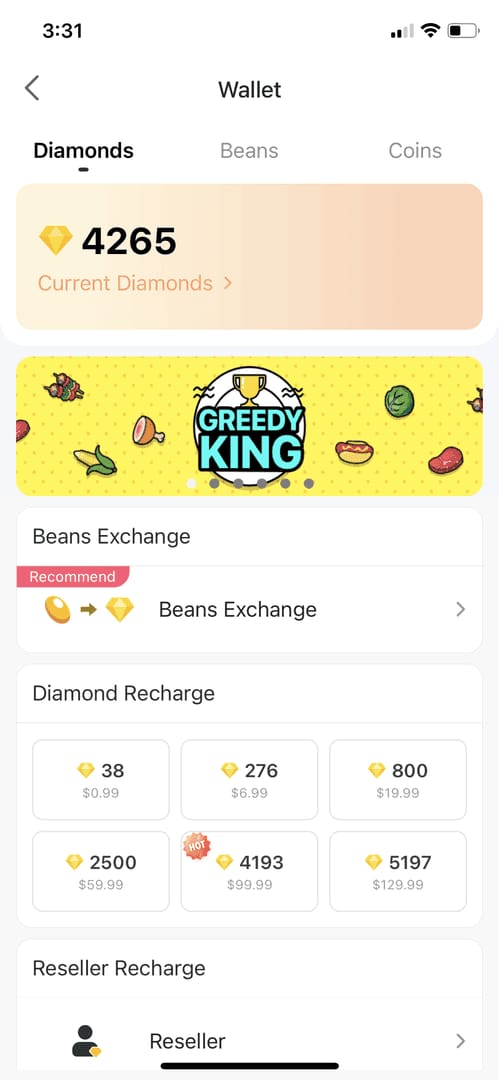
Bigo's enforcement power is broad and genuine. It just isn't pointed at "third parties" by name. The controlling language, from the BIGO LIVE User Agreement, runs: "BIGO LIVE reserves the right... to terminate your license... where we reasonably consider that: (a) your use of the Services violates this Agreement or applicable law; (b) you fraudulently use or misuse the Services."
Read what's there and what isn't. Fraud and misuse are spelled out as termination triggers. "Buying diamonds from a reseller" shows up nowhere as a violation. The peg Bigo can legally hang a ban on is fraudulent or unlawful use, a payment-behavior test rather than a channel test. That single distinction flattens most of the panic content on this topic. The platform doesn't punish the existence of an outside top-up. It punishes the money laundered through it.
Bank one more clause while you're in there: diamond purchases are non-refundable once completed, per the same agreement. That line gets very relevant the second a chargeback enters the frame, because Bigo has already told you it won't be handing anything back voluntarily.
The three things that genuinely trigger a ban
Strip out the channel-shaming and the actual ban risk collapses into three payment-side mechanisms. Bigo's fraud detection flags abnormal recharge patterns, chargebacks, and unauthorized resale, all called out in that same 2026 breakdown, and notice every one of them tracks money flow rather than which website you tapped "pay" on.
| Sourcing method |
What flags it |
Ban risk |
Likely outcome |
| Official in-app / web recharge |
Nothing |
Negligible |
Diamonds credited, account untouched |
| Legit ID-based reseller (authorized payment, ID only) |
Nothing — unless the seller's payment sours later |
Low |
Normal credit; exposure only if their funding was dirty |
| "Ultra-cheap" stolen-card seller |
Stolen payment data, fraud signals |
High |
Reversal + possible permanent termination |
| Chargeback abuse |
Payment dispute filed after delivery |
High, often delayed |
Diamonds clawed back, account suspended weeks later |
Synthesized from the BIGO LIVE User Agreement (2025) and third-party fraud-warning guides (2026).
Chargebacks are the quietest of the three, and the one most people never see coming. A chargeback opened by a reseller's payment processor can land on the account weeks after the top-up, which means instant delivery proves precisely nothing about safety. Diamonds arrive in three minutes, you gift them, you feel fine, then the account gets suspended a fortnight later when the card's actual owner disputes the charge. That lag is exactly why "why was my Bigo Live account banned after recharge" so often comes with a delay baked in. The fraud signal showed up long after the goods did.
Stolen or fraudulent payment data is the engine under genuinely too-cheap deals. Ultra-discounted diamonds carry chargeback-ban risk because fraud detection flags stolen payment information, per multiple third-party warnings (2026). When the seller's underlying card is dirty, the reversal rolls downhill to whoever received the goods. That's you.
Abnormal recharge and gifting spikes make the third trigger, and it bites people who assume they're in the clear. Dump a huge cheap top-up, then mass-gift it to one broadcaster inside a couple of hours, and you've drawn a curve that looks identical to laundering. The recharge itself can be spotless and the behavior still trips a review. Pace counts.
Telling a legitimate ID top-up apart from a stolen-card seller
This is the line that decides everything, and it usually gets flattened into a lazy "third-party equals bad." The mechanic worth memorizing: a legit ID-based reseller credits diamonds using only your numeric Bigo ID, no password, no login handover, while fraudulent operations lean on stolen cards or credential sharing, per third-party guides (2026). Plenty of users assume any outside top-up means surrendering the account. It doesn't, and a seller asking for your password is a red flag all by itself.
Green flags I look for:
- ID-only crediting. They want your numeric Bigo ID and nothing that logs them into the account.
- Transparent, traceable payment. Authorized rails (card, PayPal, recognized local wallets) with real receipts, the same payment types the official portal takes.
- Pricing that's discounted, not impossible. A real saving, not a number that can only exist because someone else is footing the bill.
Red flags that should kill the conversation:
- They want your password, OTP, or full login "to deliver faster."
- Pricing sits wildly below the official web rate with no plausible reason.
- Payment gets pushed toward irreversible, untraceable methods with no receipt.
- No verifiable identity, no support channel, pressure to buy now.
Hand login credentials to any "top-up" service and you're risking account hijacking plus the blame for fraud committed in your name, per Enjoygm's safety guidance (2026). That's a worse outcome than missing a discount. It's losing the account and being the name Bigo's logs point at.
My recharge order: official web first, in-app second
Ranked by how little it asks you to trust anyone:

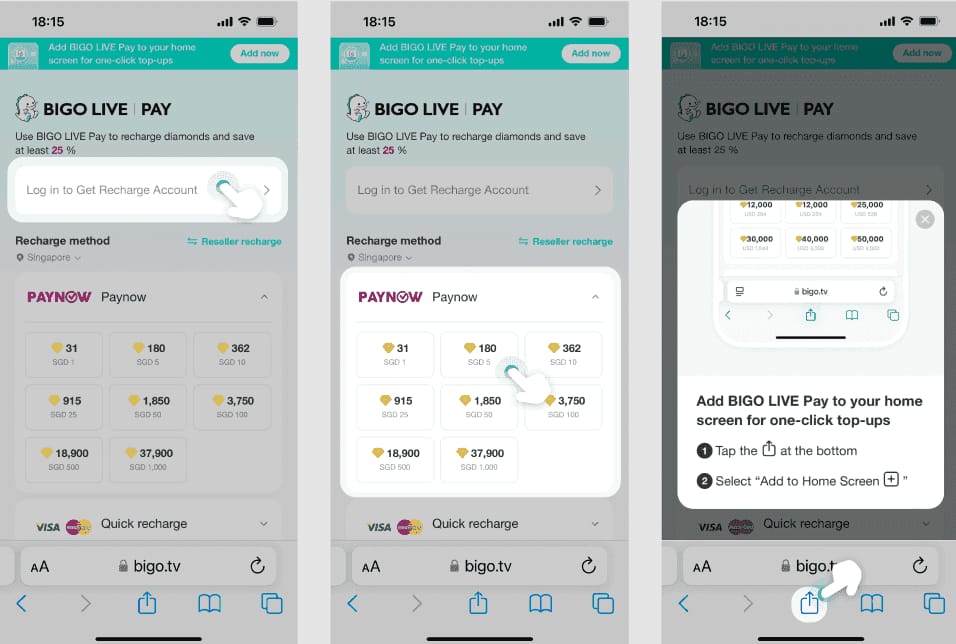
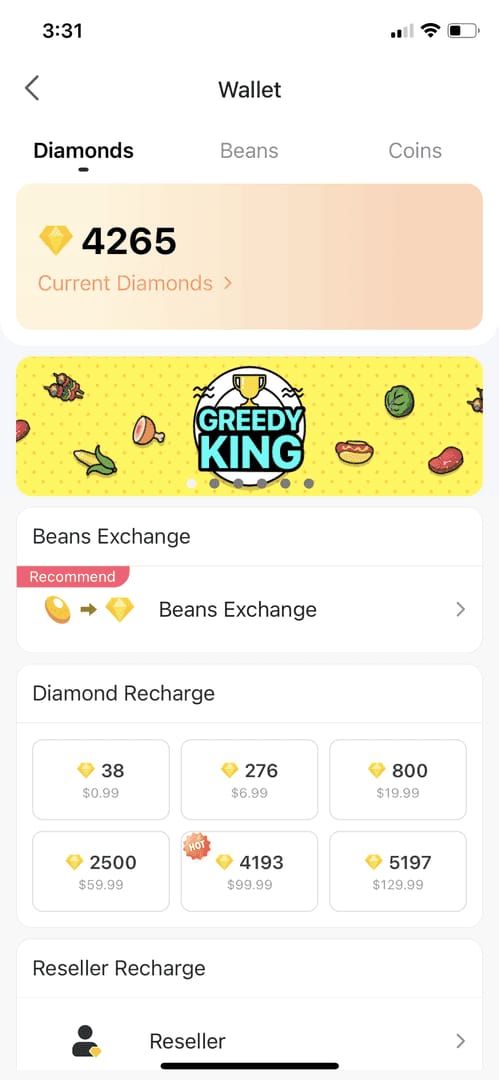
- Official web recharge first. The portal handles credit card, PayPal, and local wallets, and it prices below in-app, per the Bigo Live Recharge Blog. It's the move most people skip: official and cheaper at once.
- In-app as the fallback. Routed through Apple or Google billing via the official recharge portal, where 524 Diamonds run $9.99, 1,620 cost $29.99, and 5,450 land at $99.99. Convenient, fully protected, but you swallow the platform cut.
- A vetted ID-based partner when you want a deeper discount, picked against the green-flag list above and never on price alone.
Here's why the official web rate works as your anti-scam yardstick. Web recharge runs about $0.0196 per diamond against $0.0314 in-app, roughly 38% cheaper:
| Package |
In-app price |
Web recharge |
Savings |
| 100 Diamonds |
$3.14 |
$1.96 |
~38% |
| 500 Diamonds |
$15.70 |
$9.80 (+bonus) |
~38% |
| 1,000 Diamonds |
$31.40 |
$19.60 (+bonus) |
~38% |
Source: Bittopup.com (2026).
That ~38% gap is mostly the web channel sidestepping the app-store commission, a legitimate structural discount. So roughly a third off is normal. The trap is the offer waving 70–80% off official with no payment trail, because nobody beats Apple's cut by that margin honestly. At that depth someone else is funding the difference, and the chargeback eventually finds its way to you.
One nuance the panic crowd skips: not every steep discount is fraud. Regional pricing swings hard. The same 210-diamond pack runs about 116.82 INR (~$1.40) in India, around 20,000 IDR (~$1.40) in Indonesia, and roughly 105 PHP (~$2.20) in the Philippines against about $3.99 in the US, per Bittopup.com (2025), with Southeast Asia broadly 50–70% cheaper than the US in USD-equivalent terms. So a "cheap" offer can be honest regional arbitrage instead of stolen-card fraud. The tell is never the price on its own. It's the payment method and seller transparency behind it.
If you do weigh a vetted ID-based partner against the official route, do it with both eyes on price and crediting method. As one transparent option among the routes above, VGTopup runs an ID-based Bigo Live diamond top-up; you can buy Bigo Live Diamonds recharge cheapest price there and price it against the in-app and web rates yourself. Disclosure, not a directive.
Then lock down the account before any of it, because this matters more for ban prevention than any "safe site" badge. Recharging on an account with no two-factor authentication leaves it wide open to hijack, and a hijacked account used for fraudulent recharges gets you blamed. Switch on 2FA, verify and lock a real phone and email, keep an eye on your login activity. In my read, account security is the single biggest lever you control, ahead of channel choice.
If you're already suspended, here's the appeal path
Don't write the account off. Plenty of recharge-related suspensions reverse with the right paperwork. Appeals route through feedback@bigo.tv or the in-app feedback tool, per the help center (2026). The strongest case rests on evidence the fraud engine can't talk its way around:
- Proof of legitimate payment: receipts, transaction IDs, the card or wallet statement showing the charge was yours and authorized.
- A clear timeline linking your top-up to the suspension, written plainly.
- Account-ownership confirmation: your verified phone/email and ID details establishing you as the genuine owner rather than a hijacker.
What an appeal can't fix: the non-refundable clause holds. Even a reinstated account won't conjure back diamonds bought through a fraudulent transaction. The purchase money is gone whether the ban reverses or not. So an appeal recovers the account, not necessarily the spend.
Past about 38% off, you're probably the product
The blanket "89%" statistic deserves to get ignored. Nothing traceable sits under it, and the only variable that actually decides your fate is whether the payment behind your diamonds was clean. Get that part right and the "third-party equals ban" folklore mostly evaporates.
Who does what:
- Casual gifter topping up now and then: stick with official web recharge for that ~38% structural saving and get on with your life. At low volume the risk-to-reward on chasing a deeper cut doesn't pencil out.
- Bargain hunter chasing the floor: a deep discount is only safe when it's regional pricing or a transparent, ID-only authorized payment, never an anonymous seller quoting an impossible rate. Anything 70%+ under the official web price is a chargeback waiting to land.
- Active broadcaster whose livelihood rides on the account: treat ban-stakes as the deciding factor. Official channels, 2FA locked down, gifting paced so a post-recharge spike never reads as laundering. A few dollars saved aren't worth a permanent termination.
The smart money isn't on hunting the cheapest possible diamond. It's on never inheriting a stranger's fraud and never leaving the account open to hijack. Do those two things and the scary headline stops applying to you.
Frequently Asked Questions
A legit promo code run through an official channel won't flag anything. Discounts aren't the trigger; fraudulent payment is. The risk shows up only when a "code" is really a front for a stolen-card transaction or demands your login details. Codes on the official web portal or a transparent ID-based partner are fine. Codes that want your password aren't.
Does Bigo Live offer official diamond top-ups outside the app, and are they cheaper?
Yes. The official web recharge portal is a fully sanctioned route outside Apple/Google billing, and it's genuinely cheaper, running about 38% under in-app with the per-diamond figures laid out above. It takes cards, PayPal, and local wallets, per the Bigo Live Recharge Blog. That structural saving exists because the web channel skips app-store commission, not because anything shady is going on.
Can a casual gifter realistically get banned, or is this only a whale problem?
Volume isn't the deciding factor. Payment source is. A low-spending gifter on authorized payment carries negligible risk no matter how small the top-up, while a single transaction funded by a stolen card can trip a reversal. The one volume-linked trap: dumping a large cheap recharge and mass-gifting it within hours can draw a fraud review on its own, so pace matters more than total spend.
If my banned account gets reinstated, do I get my diamonds back?
Not necessarily. Diamond purchases are non-refundable once completed, per the BIGO LIVE User Agreement, and a successful appeal restores access to the account while the money spent doesn't come along with it. If those diamonds came through a transaction that later reversed via chargeback, that balance is generally gone even after reinstatement. Recovering access and recovering money are two separate outcomes.
Is buying Bigo diamonds outside the app even legal?
Buying through an authorized, ID-based reseller on your own legitimate payment isn't illegal, and nothing in the user agreement bans external channels by name. The document targets fraudulent or unlawful use. The legal and policy trouble starts when the underlying payment is stolen or when you hand over account credentials. The payment method decides legitimacy here; the channel barely matters.








Comments